Agency vs In-House
Agency or In-House: Two Ways to Buy the Same Ceiling
The slide says ROAS 4x.
The slide says ROAS 4x.
It is a nice slide. Branded deck, clean charts, the account lead has circled the big number in blue. The last page is the recommendation: lean in, add budget, Q4 is the window. The Head of Growth signs off.
Then she opens a second tab. GA4, then MER. She runs the numbers herself, the way she always does after these QBRs, and they do not agree with the deck. Not a little disagreement. The MER tells a different story entirely.
The question that lands in that second tab is not "is this agency good." It is harder: who is running my growth better than it is being run right now, and what does that actually cost me?
That question leads most brands to one of two conclusions. Fire the agency and hire in-house, or find a better agency. The agency vs in-house growth team debate treats these as opposites. Both are reasonable. Both are also, structurally, the same move: two ways to buy the same ceiling.
What Agency-or-In-House Actually Decides
The debate gets framed as build-vs-buy, which sounds like the right frame. Buy capacity from an agency, or build it internally. But build-vs-buy is about where the work happens. The question that matters is different: what compounds on your account over time, and what leaks out every time the structure changes?
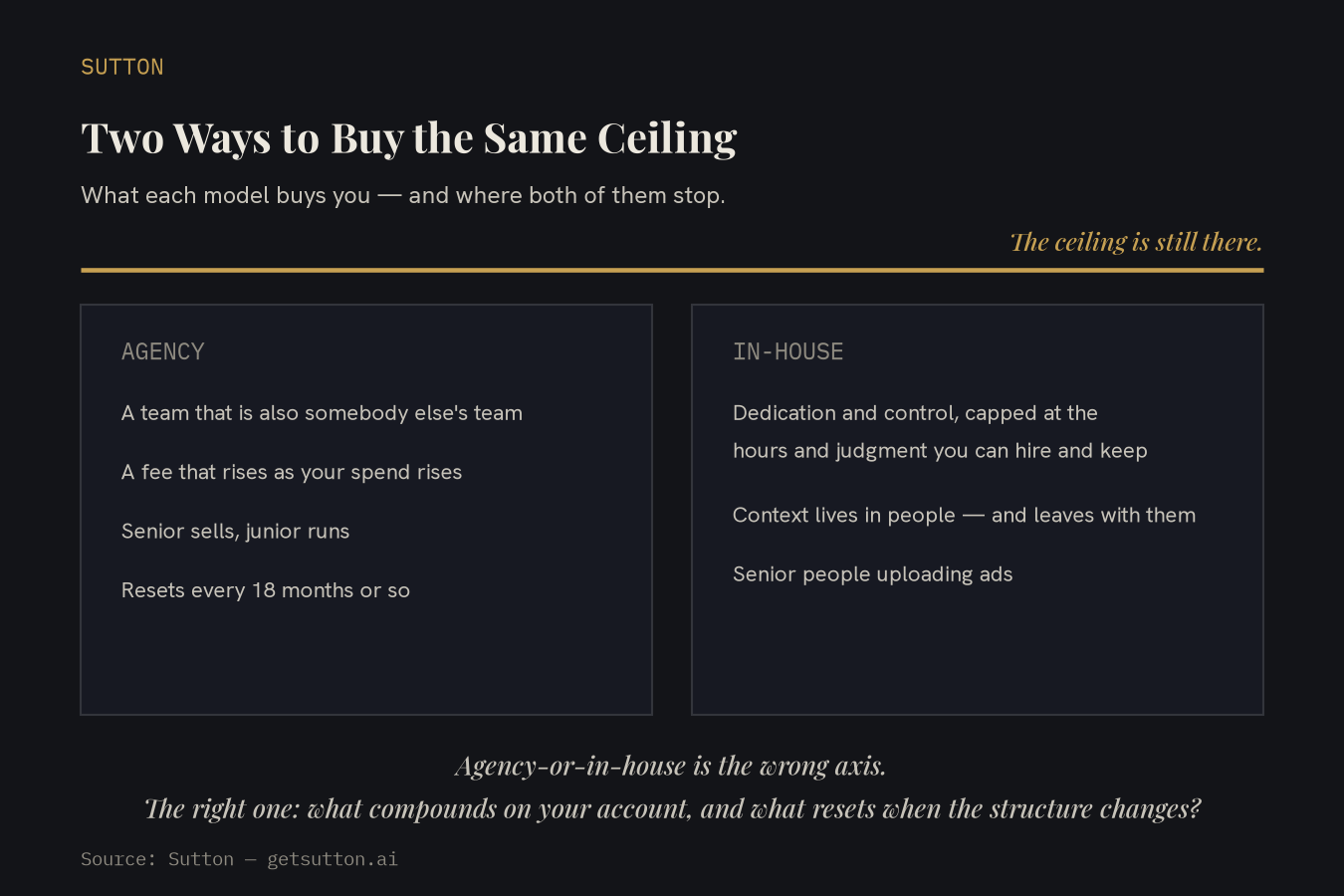
At a $30M+ brand running $250K or more a month in paid media, neither model answers that well. The agency buys you a team that is also somebody else's team, on a fee that rises as your spend rises. In-house buys you dedication and control, capped at the hours and judgment of the people you can hire and keep. The ceiling looks different on each side. The ceiling is still there.
What an Agency Gives You, and What It Structurally Cannot
A performance or growth agency gives you a team, cross-account pattern recognition, and speed to start. Real things. They matter more at $5M than at $50M, but they are not nothing at any scale.
What the standard agency model cannot give you is aligned incentives. This is a structural problem, not a character problem with any particular agency.
The performance-agency standard is a retainer plus 10 to 20 percent of your ad spend. That structure means the agency earns more every time you spend more. It does not earn more when your money works harder. As Olivia at Haus put it: "agencies are mostly billing on percent of spend, and they have no incentive to tell or suggest to a brand that they slow down." That corroborates what the math already shows. Your agency's cut goes up when you overspend, and stays flat when you go quiet and let a winner compound.
The second problem is the gap between who sells and who works. Senior sells, junior runs. The account lead who impressed you in the pitch is not the person uploading your creative variations on a Tuesday. Between them sits an account manager whose job is to translate, not to run growth. You pay a senior invoice and get junior execution. No individual agency chooses this; the org chart makes it likely.
Nik Sharma at Sharma Brands: "No one is FULLY dedicated to your account." That is from inside the industry. Full dedication is the thing the agency model structurally cannot deliver, because dedication requires a single client, and the economics require a book of them.
What In-Housing Gives You, and Where It Hits
The appeal of in-housing is real. Dedication. Control. Someone whose sole job is your brand, not a rotation across a client roster. At the scale where in-housing becomes viable, the economics look compelling on paper: what you pay in agency retainer and percentage of spend can fund two or three senior hires.
Connor MacDonald, CMO at Ridge, on the decision: "We're pretty much 100% internalized, and we were looking at the fees that we were paying some of these buy spend agencies. We're like, we should hire two more creative strategists, it'll be a fraction of the cost, but probably better quality."
That decision is right. And the ceiling is still there.
The ceiling you hit with in-housing is not visible until you are already inside it. You have hired well. You have the people. And those people spend time on things that do not justify their compensation. Cody Plofker at Jones Road Beauty: "I had senior growth people who were uploading ads. You should be getting that off your plate to spend time on the higher-leverage things."
In-housing removes the agency overhead. It does not remove the junior-grade work. It moves that work onto a more expensive payroll and asks senior people to absorb it.
The deeper ceiling is harder to see. A team of two or three people, however good, caps your funnel coverage at their bandwidth. If your media buyer is on holiday, media planning pauses. If your creative strategist leaves, creative strategy leaves with her. The institutional knowledge that makes a good growth team effective is stored in individual heads that take two weeks in August and get better offers from other companies.
The Cost Brands Underestimate: Staffing the Whole Funnel
Here is the math neither model makes explicit.
Running a $30M+ brand's growth function well requires coverage across five distinct skill sets: paid media, creative strategy, landing page and CRO, SEO and content, email and retention. These are not variations on one skill. A strong media buyer is not a strong copywriter. A strong creative strategist is not a strong CRO practitioner. The overlap lives at the margins.
At fully-loaded senior compensation, real coverage across all five starts at the number that usually stops the conversation. And coverage is fragile. One resignation, one parental leave, and it stalls in the function that person owned.
Most brands do not staff all five at senior level. They make choices: strong on paid, thin on email; strong on creative, light on CRO. Reasonable choices, given the budget. But they mean the funnel has seams. Work gets handed off between functions, and each handoff is a place where context leaks.
The agency has seams between the account manager and the specialists. The in-house team has seams between the senior hire and the functions they cannot cover. The hybrid, some in-house and some agency, inherits both sets and adds a new one: the handoff between the two, where context leaks fastest because neither side owns the whole picture.
The thing neither model addresses is funnel-wide context that persists. What worked in Q1, what your creative testing taught you about this audience's response to social proof, what the email sequence learned from the cohort that came in through the listicle in March: that knowledge lives somewhere in both models, but it is distributed, and every time a person leaves or a relationship ends, a portion of it does not transfer.
The Strongest Objection, Answered Honestly
The honest version of the case for staying with a good agency is this: a strong shop with genuine craft and real case studies in your vertical can run growth well. Some agencies have senior talent, real cross-account perspective, a track record worth paying for. The critique of the model does not mean every agency is incompetent.
The counter is structural, not about competence. A better agency is a higher ceiling, not a removed one. The percentage-of-spend model bakes the misalignment into the economics, regardless of how good the work is. And senior-sells, junior-runs is a function of how agencies staff to stay profitable at retainer rates, not a choice made in bad faith.
The in-house case has an equally honest version: dedication is worth something the agency cannot match. A person whose single job is your brand brings a kind of attention a client on a rotation cannot. The counter is also structural: dedication caps at the hours and judgment of the people you can hire and keep, and the funnel-wide context still lives in individual heads.
Most brands, thinking clearly, are already running a hybrid. The binary is a rhetorical simplification. But the hybrid inherits both ceilings and adds the handoff seam between them. In-house team and agency rarely share one view of what the funnel knows about the audience. Each holds a partial picture, and the partial pictures do not combine on their own.
The Real Axis: Ceiling or No Ceiling
Agency-or-in-house is the wrong axis. The right one is: what compounds on your account, and what resets every time the structure changes?
An agency relationship resets every time the team rotates, every time you switch shops, every 18 months or so for the brands that ride the carousel. Each reset is a re-onboarding, a stretch where the new team learns what the old team knew. You pay for that in the months where the work runs on less context than it had before.
An in-house team's context lives in its people. When they leave, it goes with them. Most in-house leaders have watched a strong senior hire walk out and realized, in the weeks after, how much institutional knowledge left with them.
The thing that removes the ceiling is not a better agency or a stronger in-house team. It is one persistent intelligence across the whole funnel, holding context across every channel, every test, every cohort, with no re-onboarding and no knowledge leak.
That is what we built, because neither the agency route nor the in-house route answered the question the second browser tab asked.
One compounding brain across your whole funnel is worth more in month 12 than month 1: nothing re-onboards and knowledge does not leak out the sides. That is the architectural fact of the model, not a performance promise. Month 12 knows everything month 1 learned, and everything in between.
The fee follows the same logic. A fixed monthly fee, no percentage of your ad spend, ever. The incentive is result-per-dollar, not volume. You do not pay more when you spend more. The model wins when your money works, not when you spend more of it.
Behind the model sits $150M in DTC sales driving 6 exits across our founding team. That judgment is encoded in the intelligence running the account, which means every decision is informed by operators who have sat in the exact seat the QBR slide puts you in, opened the same second tab, and had to decide what to do about it.
Media buying, to be explicit: planned, structured, and briefed by the intelligence, approved by a human before a dollar moves. Not autonomous. Not hands-off. The human gate is the model.
Back to the QBR
The slide still says ROAS 4x. The second tab still tells a different story.
The question at the end of a good QBR is not "should we add budget" or "should we fire the agency and hire in-house." It is simpler, and harder: who is running this on one brain, graded on my numbers, on a fee that does not reward spending more?
That question has been available for a while. Most brands just needed someone to say it out loud.