AEO & SEO
Answer Engine Optimization for DTC: The Buyer Now Asks an AI, and It Either Names You or It Doesn't
She asked her friend the way you ask which restaurant is worth trying on a Friday night.
She asked her friend the way you ask which restaurant is worth trying on a Friday night. She was shopping for a skincare brand, something specific, so she pulled out her phone, typed the question into ChatGPT, and waited.
The AI took a beat. Then it named three brands, gave a short rationale for each, and showed a citation list.
Her colleague, the Head of Growth at one of those skincare brands, was sitting across the table. She watched a purchase decision form in thirty seconds, shaped by an answer she had no visibility into. Her Google rankings were fine. Her traffic dashboard showed nothing unusual. The conversion numbers looked healthy.
The sale that didn't happen never showed up anywhere.
That is the shape of the problem. Not a technical failure, not a ranking penalty. A discovery loss that leaves no trace in your analytics, because it happened on a surface you are probably not measuring.
What AEO Is, and Why the Win Condition Changed
Search engine optimization was always about ranking a page: the better your page, the higher it sat in a list of ten blue links, and the user chose one to click.
That unit of visibility is eroding. Google's AI Overviews now sit above the classic link list for a growing share of queries. ChatGPT, Perplexity, and the assistants built into browsers return a single synthesized answer, not a page of options, cite a handful of sources, and name specific brands when the question is a buying one.
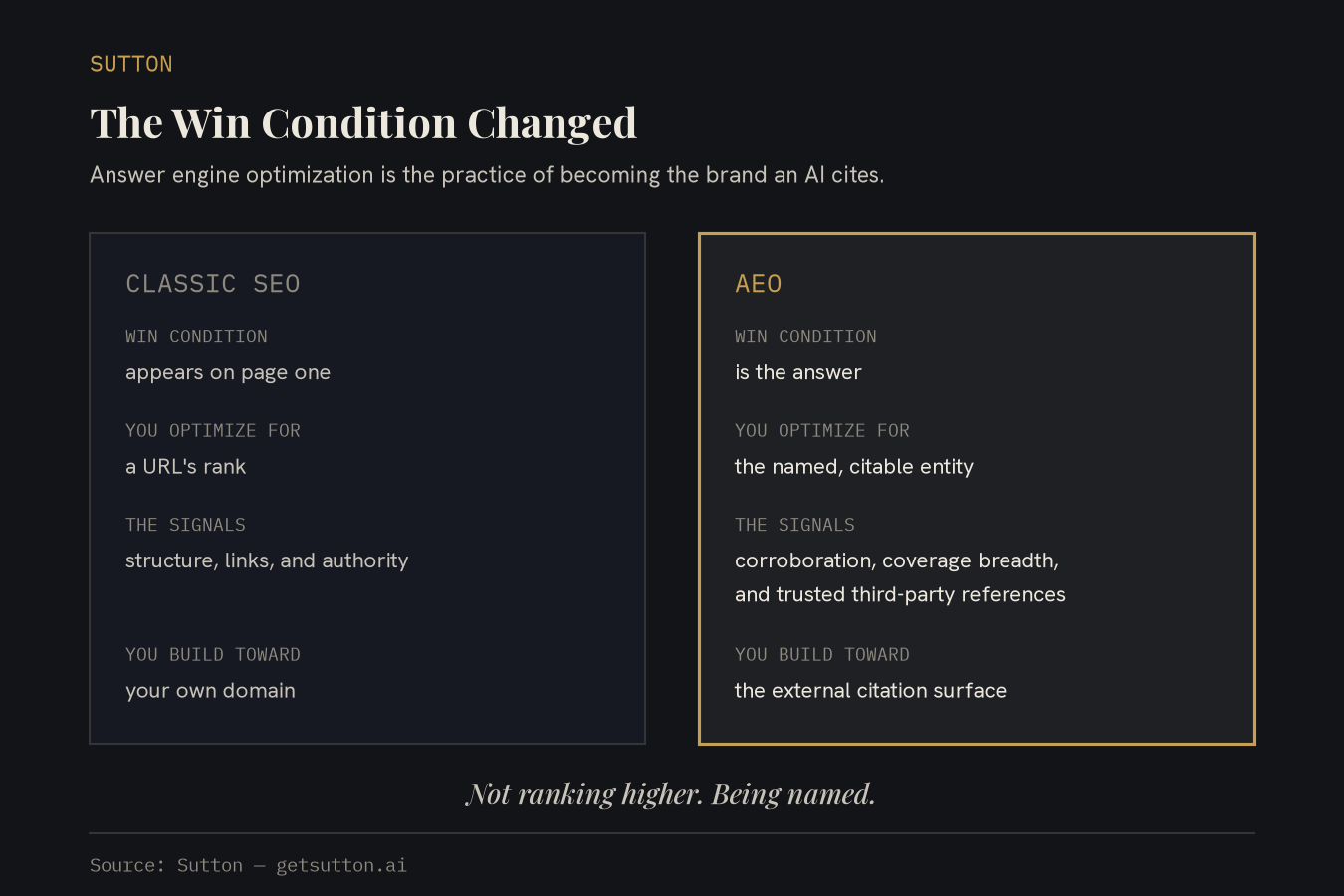
Answer engine optimization is the practice of becoming the brand an AI cites. Not ranking higher. Being named.
That is not a subtle distinction. It changes what you optimize for, how you measure whether it is working, and what content actually moves the needle. The win condition shifted from "appears on page one" to "is the answer."
Why the Citation Graph Beats Keyword Density
Here is the part that surprises most growth leaders the first time they hear it.
Published analyses of AI Overviews have consistently found that a large share of the pages an AI cites do not rank in the top organic results for the same query, and some do not rank on the first page at all. Being on page one is neither necessary nor sufficient to be cited.
The reason is how a model decides which brands to trust. AI answers are not built from live keyword matching. They are built from what the model learned in training, plus what it retrieves and weighs the moment you ask. The question it answers is not "which page ranks highest for this keyword." It is closer to "which brands has the information ecosystem described, corroborated, and cited across the sources I trust?"
Call it the citation graph. A brand written about by independent editorial sites, compared by credible third parties, and cited in category explainers has a footprint in that graph, and the model has learned it is real and notable. A brand that poured everything into its own product pages and its own blog, with little coverage in trusted environments elsewhere, can rank well on Google and stay invisible to the synthesized answer.
That is the keyword-versus-citation mismatch. You can dominate your own domain and still not exist in the answer box.
The Uncomfortable First Read
Most DTC brands, when they look honestly at how they show up in AI answers, find the picture is thin.
That is not a criticism. It is a timing observation. The shift to synthesized answers has been fast, and the editorial footprint that makes a brand citable (independent coverage, corroborated mentions, well-cited category content) compounds slowly. A brand heads-down on its own site has almost certainly been under-investing in the external citation surface, not because anyone chose wrong, but because no one was measuring it.
The honest first move, before any optimization play, is a directional audit: a read of how your brand actually shows up in AI answers today. Which queries name you, which skip you, where the citable gaps sit, and what content the models appear to trust in your vertical.
Not an ongoing rank-tracker. A snapshot you act on. Your response depends entirely on the kind of gap you have. A brand cited for the wrong things needs a different move than a brand that never appears. A category where AI answers lean on three trusted properties calls for a different plan than one where the graph is wide open.
The Two Objections, Answered Straight
"Isn't this just SEO with a new name?"
The strongest version is fair. AI answers still pull heavily from the open web, so credible, well-structured content still matters. Good SEO practice is not irrelevant.
But the win condition changed, and optimizing for the wrong one is expensive. Classic SEO tuned you to rank a URL, on signals of structure, links, and authority. AEO tunes you to be the named, citable entity inside a synthesized answer, on signals of corroboration, coverage breadth, and trusted third-party references. The inputs overlap. The outputs you are trying to move do not. A brand that spent five years on an excellent blog and a clean site can rank fine and still be absent from the answer, because it built toward its own domain instead of toward external citation.
"If I can't see it in my analytics, how do I trust an audit?"
The right question, and it does not have a tidy answer yet. Measuring AI citation share is genuinely hard. There is no native pipe between most analytics stacks and the answer surface; you cannot pull an AI-citation report from GA4. Direct measurement is either manual (running query sets through the tools and recording whether your brand appears) or dependent on emerging third-party trackers still being validated.
What an audit gives you reliably: your current footprint, the editorial gap relative to brands being named, and which content territories would produce citable material. What it cannot give you: a promised ranking, a passive number to watch, or proof of revenue before the work compounds. Anyone selling that is selling a subscription to a figure they cannot actually move for you. Treat this as a content-strategy decision with a long compounding arc, not a performance buy with a thirty-day return.
What the Audit Tells You, and What It Honestly Can't
A directional AI-visibility audit tells you three things. Your current footprint: the queries and categories where you are already cited, so you know what to protect. The citable gap: where competitors or editorial properties get named and you do not, which is where investment closes distance. And the category trust map: which kinds of sources the AI weights in your vertical (independent editorial, retailer comparisons, review aggregators, category explainers) so effort goes toward what actually feeds the answer.
What it cannot tell you is how long the work takes to compound, what your citation share will be in six months, or whether any single piece of content will get cited. The citation graph rewards consistent, credible presence over time. There is no paid placement. The brands that own this surface in 2027 are the ones building external citation footprint now, while their competitors still optimize for page rank on a surface that matters less every quarter.
Back to the Answer Box
The buyer at that table pulled out her phone to ask a question she trusted an AI to answer. It named three brands and gave a rationale. She probably bought one of them. That kind of moment is not rare, and it is not going to reverse. AI-first discovery is a structural shift in how considered DTC purchases get made, and it is happening while the citation graph is still thin enough that an investment made now compounds for years.
The first step is a snapshot, not a subscription: a directional read of where you already show up, where the citable gaps are, and what content would make you the named answer.
Before we offered that read to anyone, we ran it on one of our own DTC brands, Covelle, in July 2026. We wanted to see our own gaps on our own money first. The result was humbling in the ordinary way, plenty of citable ground we had simply never covered, because no one was measuring the surface. That read is the AEO door in Sutton's SEO and AEO function: an AI-visibility and content-opportunity audit, a directional read of how your brand shows up in AI answers and where the citable gaps are. Sold as an audit, not a tracker. The judgment behind it is encoded: $150M in DTC sales driving 6 exits across our founding team.
You act on the snapshot. The compounding is the work. The buyer is already asking. The only question is whether the next answer names you.