The $30M Wall
The $30M Wall Isn't One Problem. It's Three, and They Break at Once.
You walk out of the quarterly business review with a deck full of green arrows.
You walk out of the quarterly business review with a deck full of green arrows. Every channel up and to the right. ROAS numbers your agency worked hard to make look good, because that is, after all, their job this quarter. Eleven floors down in the elevator, you open your own GA4 out of habit more than doubt. The blended number has barely moved.
Your name is on the growth number, not the agency's. The dashboards upstairs say you are winning. The P&L your CFO reads on Monday says you are not. For the first time in this job, standing in a moving box between two floors, you cannot tell the board which one is true.
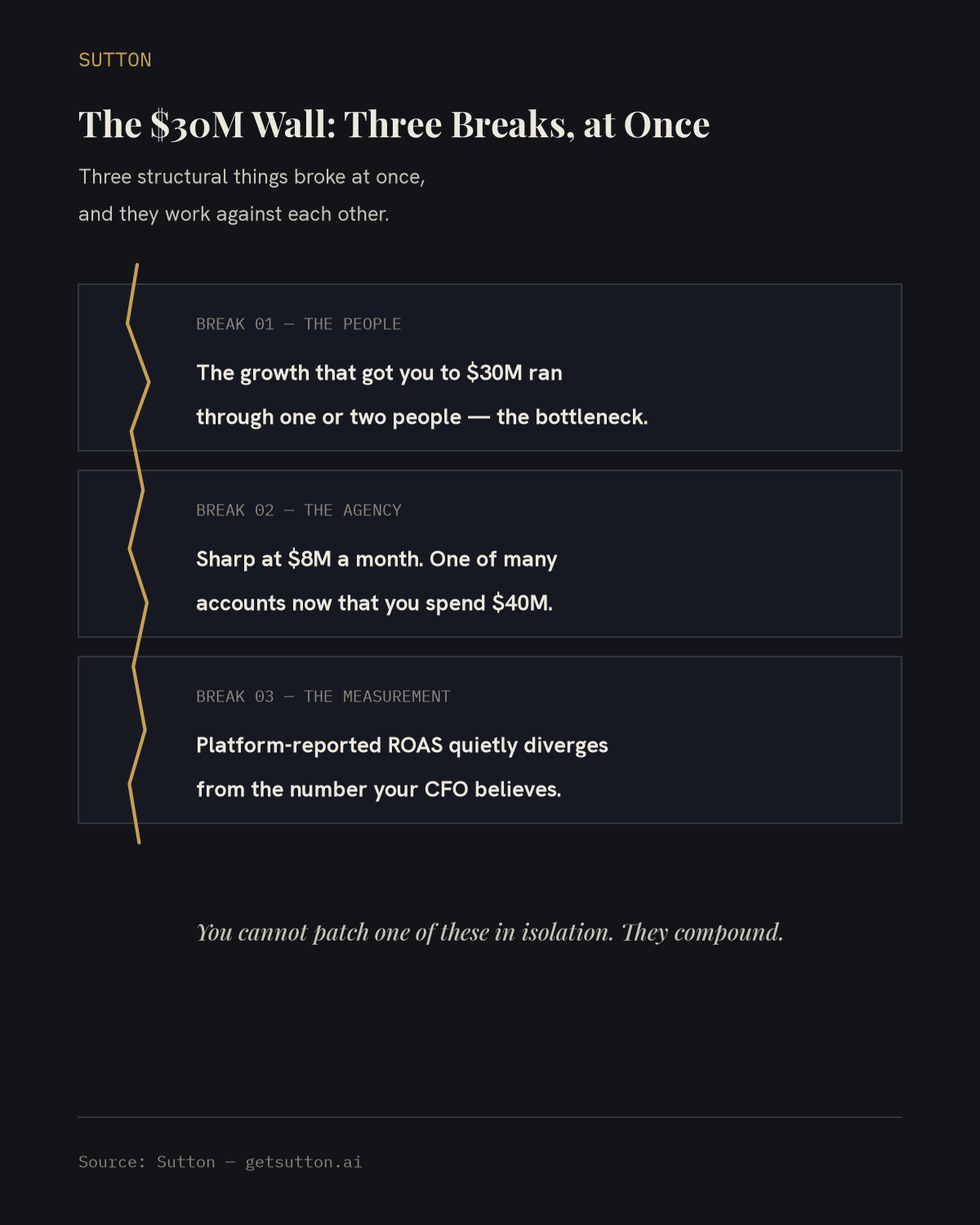
The tactics did not stop working. Three structural things broke at once, and they work against each other. The growth that got you to $30 million ran through one or two people who are now the bottleneck. The agency that was sharp at $8 million a month is one of many accounts now that you spend $40 million. And the platform-reported ROAS everyone was so proud of quietly diverges from the number your CFO believes, right when the bets get bigger. You cannot patch one of these in isolation. They compound.
The growth in your head is not an asset. It is a single point of failure.
Ask who actually knows why your best-performing audience is about to fatigue, and the honest answer is a name, not a system. It is the media buyer who has run this account long enough to feel a dip coming three days before the dashboard shows it. Or the founder, still the only person willing to kill a hero creative everyone else is excited about, because they built the brand and know what it is supposed to sound like.
That was fine at $8 million a month. One or two sharp people can hold an entire growth motion in their heads when it is small enough to hold. At $40 million it is not one motion. It is a dozen, running in parallel, across channels that did not exist eighteen months ago. The people who carried you here become the ceiling, not because they got worse, but because their attention never scaled with the spend.
And it is a flight risk. The read on audience fatigue lives in a person, not in anything written down. The media buyer leaves and takes it with them. The founder stops reviewing every creative because there is too much of it now, and the taste goes quiet. None of what built the growth survives a resignation letter or a bad month where the one person you depend on stops answering Slack.
The agency that fit at $8M is, structurally, the wrong agency at $40M.
The second break is the one every operator recognizes the moment you say it out loud: the shop that was exactly right at $8 million a month is the wrong shop at $40 million, even if nobody there did anything wrong.
At $8 million, you were a meaningful account, and someone senior ran point on your business. At $40 million you are one of many, and the agency's staffing economics have not changed even though yours have. "No one is FULLY dedicated to your account," says Nik Sharma of Sharma Brands, describing the arithmetic of agency staffing, not any single shop's failure. Senior talent gets spread thin across a book of clients. Your account gets whoever has bandwidth this week.
Then there is the fee. Retainer plus 10 to 20 percent of spend was invisible when your spend was small. At $250,000 to $2 million a month, that percentage becomes one of the largest line items your CFO can point to, and it rewards exactly the wrong thing: spending more, not making the spend work harder. The incentive is baked into the invoice before either of you says a word.
So brands switch agencies, and the switch resets the clock. What one shop learned about your audiences, your seasonality, your creative fatigue curve does not travel with you. The relationship restarts from zero roughly every eighteen months, and you pay full tuition again.
The stakes get bigger exactly when the measurement gets murkier.
Every ad platform grades its own homework. Meta reports on Meta's view of the world. Google reports on Google's. Each has every incentive to show you the version of reality where its own spend looks responsible for the sale. "Every platform is grading its own homework," says Curtis Howland. "And every platform gives itself an A+."
That was manageable when your spend fit inside one channel and one dashboard. It stops being manageable once you run paid social, paid search, affiliate, and email at once, each with its own attribution window, each claiming credit for overlapping conversions. The reported numbers do not just diverge from reality. They diverge from each other. Add every platform's self-reported number together and you can, on paper, take credit for more revenue than the brand actually made.
Your GA4 and your MER do not have that problem, because they are graded against a single reconciled source of truth: the money that landed in the bank. That is why the elevator moment feels like a small betrayal. The QBR deck was not lying. It was reporting truthfully from inside a system built to flatter itself. Your own numbers have nothing to gain from flattering you, which is why they are the ones your CFO believes.
Two honest objections
Two objections are worth taking seriously, because dismissing them would be dishonest.
The first: this is just the ordinary law of large numbers. Every brand's growth rate slows as it gets bigger, and there is nothing structural to fix, just physics. True, as far as it goes. A brand cannot grow off a $40 million base at the rate it grew off a $2 million one, and no operator, agency, or system changes that arithmetic. But that is a top-line-percentage story, and this is a different one. What is described here is not deceleration. It is effectiveness leaking through three coordination seams, each survivable alone, compounding once they hit together. Some of your slowdown really is unfixable size. Most brands mistake fixable coordination loss for unfixable size gravity, and stop looking for the difference.
The second: so hire a strong in-house team and cut the agency loose. This is often the right move, and it is not a strawman. In-housing genuinely solves the dedication problem, and it can solve the fee-math too. But it recreates the first break in a new form. Now your one strong senior hire is the bottleneck, and the knowledge still walks out the door the day they take another job. It does not touch the third break either: your new team still reconciles platform numbers against the P&L by hand, on a spreadsheet, every Monday morning. It is a real fix for one problem, sold as a fix for three.
What actually has to change
Not a better agency. Not a better hire. Coordination, incentives, and truth, all three at once, because fixing one and leaving the other two in place just moves the leak somewhere else.
Coordination means one intelligence sitting across the whole funnel that does not reset when a person leaves or an agency contract ends, worth more in month twelve than it was in month one because nothing has to be re-explained. Incentives means a fee that rewards result-per-dollar, not volume, structurally, not as a discount someone negotiated in a renewal call. Truth means grading every decision against your own GA4 and MER, not whichever platform is grading its own homework this quarter.
This is the fourth option the piece has been building toward. Not an agency, not a hire, not a dashboard tool. Sutton is an AI with the encoded judgment behind $150M in DTC sales driving 6 exits across our founding team, running on a fixed fee with no percentage of spend, graded against your own GA4 and MER rather than a platform's self-reported number. It plans, structures, and briefs the media; nothing goes live until you approve it. It is not the only way to solve this. It is the one built because the three breaks here do not yield to a single fix, and somebody needed to build the thing that could hold all three at once.
Same elevator, a year later
Picture the same elevator, a year later. Same QBR upstairs, same deck, same green arrows. This time, when you open your own numbers on the way down, they say what the deck just said. Not because the deck got more honest, but because the number the deck is built from and the number your CFO reads are, for the first time, the same number, checked against your own GA4 by something with nothing to gain from telling you what you want to hear. You reach the ground floor in the same forty seconds. What is different is that you already know exactly what you are about to tell the board. And you are right.