Measurement & P&L
The Record Quarter Was the Warning
You close the best quarter the brand has ever posted, the number goes up in the all-hands deck, and somebody claps.
You close the best quarter the brand has ever posted, the number goes up in the all-hands deck, and somebody claps. Six weeks later, same team, same playbook, same spend, and the chart that had climbed for eighteen months goes flat.
Not down. Flat. Flat is worse, because flat leaves room to argue about why.
The room reaches for the market first. It always does. iOS, someone says. CAC is up across the category, someone else says, pulling up a competitor's feed that looks a little quieter this week. Someone mentions the economy in the vague way people do when they don't have a better answer. The meeting ends with a plan to test new creative and a promise to revisit CAC targets next quarter.
The number on the wall said the market had turned. It hadn't.
Three things inside the building had, and the record quarter is what pushed all three past what they could carry. A stall right after your best year is not a demand problem. It is a load test. The systems that got you to $15M a year buckle at $35M, for the same reason a bridge rated for cars fails the day a convoy of trucks crosses it. Nothing about the bridge changed. The load did.
Break one: growth still lives in one or two heads.
Every fast-scaling brand has one. The person who just knows which creative to cut and which audience to push another 20% into, who reads a Klaviyo flow and tells you in ten seconds why it stopped converting. Nobody trained them. They built the instinct campaign by campaign, and for years that concentration was the whole advantage. One sharp person moving fast beats a committee, and everyone agreed not to slow them down by asking them to write anything down.
Then that person takes a two-week trip. The account idles. Spend sits where it was left instead of shifting toward what's working, because the shifting was never written down, it lived in one head, and that head is on a beach.
The dip shows up in the numbers exactly the shape of the vacation. The growth engine has a single point of failure, and it has a name and a calendar. Research tracking companies whose growth suddenly stalled, across roughly fifty years of large-company data, found thin talent depth, not enough people capable of running the machine at its new size, among the internal causes that show up again and again. It rarely arrives as a resignation letter. It arrives as a dip shaped like somebody's calendar.
Break two: the agency that fit at $8M doesn't fit at $40M.
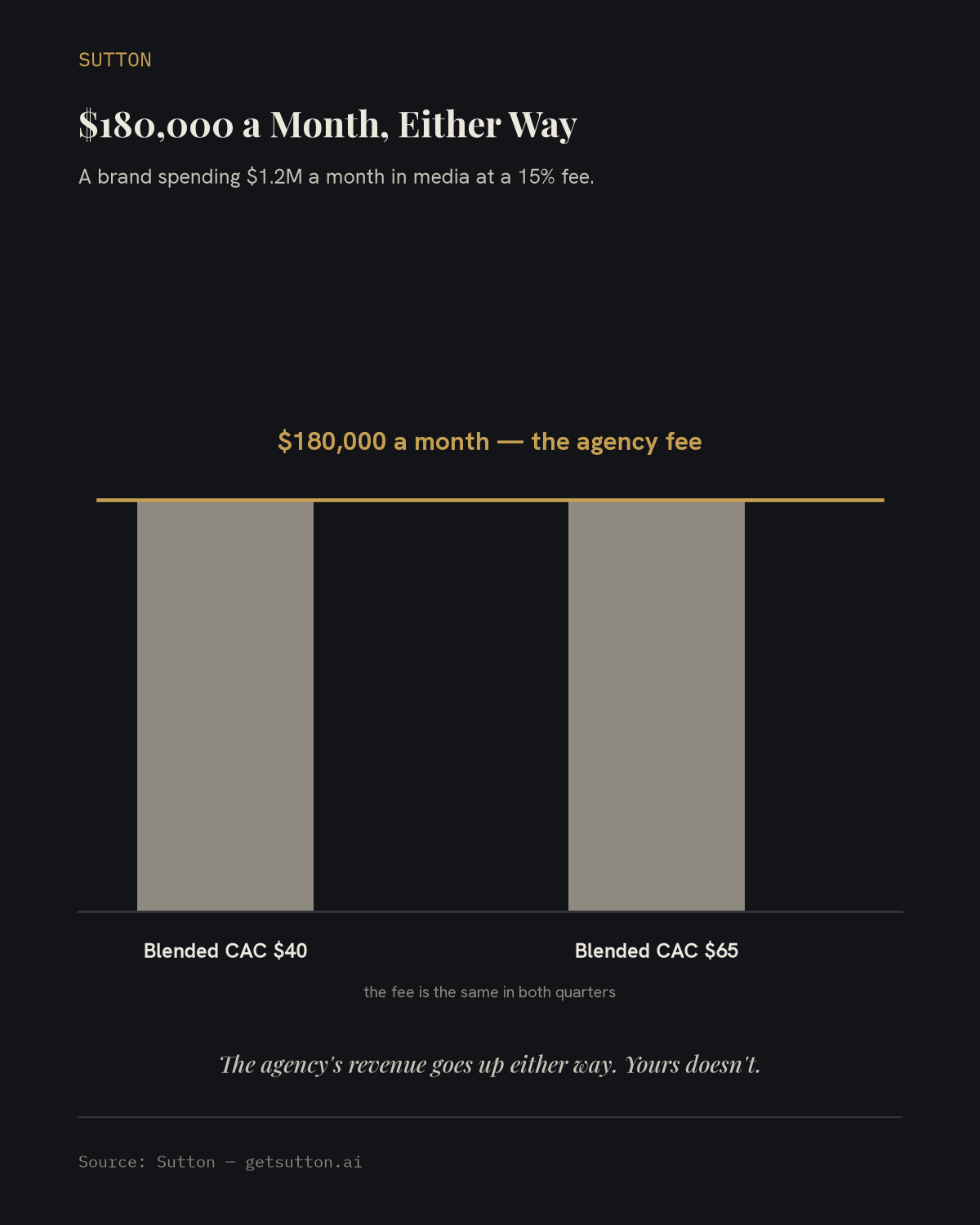
The scene is the quarterly review. The senior person who won the pitch two years ago is on the call for the first ten minutes, warm, asks about the kids, then drops off to let the team walk you through the deck. The team is someone three months into the account, reading slides they didn't build. The retainer has grown every quarter you've spent more, because that is how the fee is built: a base plus a percentage of spend, often 10 to 20% on top of a seven-figure media budget. A brand spending $1.2M a month at a 15% fee pays $180,000 a month whether the blended CAC is $40 or $65. The agency's revenue goes up either way. Yours doesn't.
Nik Sharma, who has sat on the brand side of exactly this table, put it plainly: "No one is FULLY dedicated to your account." That is not a complaint about effort. It is a description of the incentive. The shop that was hungry and senior-staffed when you spent $200K a month has marquee logos on the homepage now, your account is one of forty, and the fee rewards them for you spending more, never for you spending smarter.
Break three: your own numbers stopped agreeing with each other.
This scene is quieter. Meta says its campaigns run at a 4x return. Google says its own are the ones actually working. TikTok has an attribution story too. Add an affiliate channel and a retention platform and you have five dashboards, each confident, each self-reported. The finance team closes the month and the bank account agrees with none of them.
Nobody in the chain is lying. Curtis Howland, who has run north of $30M a year in ad spend for DTC brands, described the mechanism exactly: "Every platform is grading its own homework. And every platform gives itself an A+." The more channels you add, the more self-interested scorekeepers you trust at once, and the gap between what the dashboards claim and what the P&L shows widens in proportion to how fast you grow.
"It really was the market this time."
This is the strongest objection and it deserves a straight answer. Costs did rise across the category. Tracking did degrade after the privacy changes. The environment is harder than it was three years ago. Dismissing that would be its own kind of dishonesty.
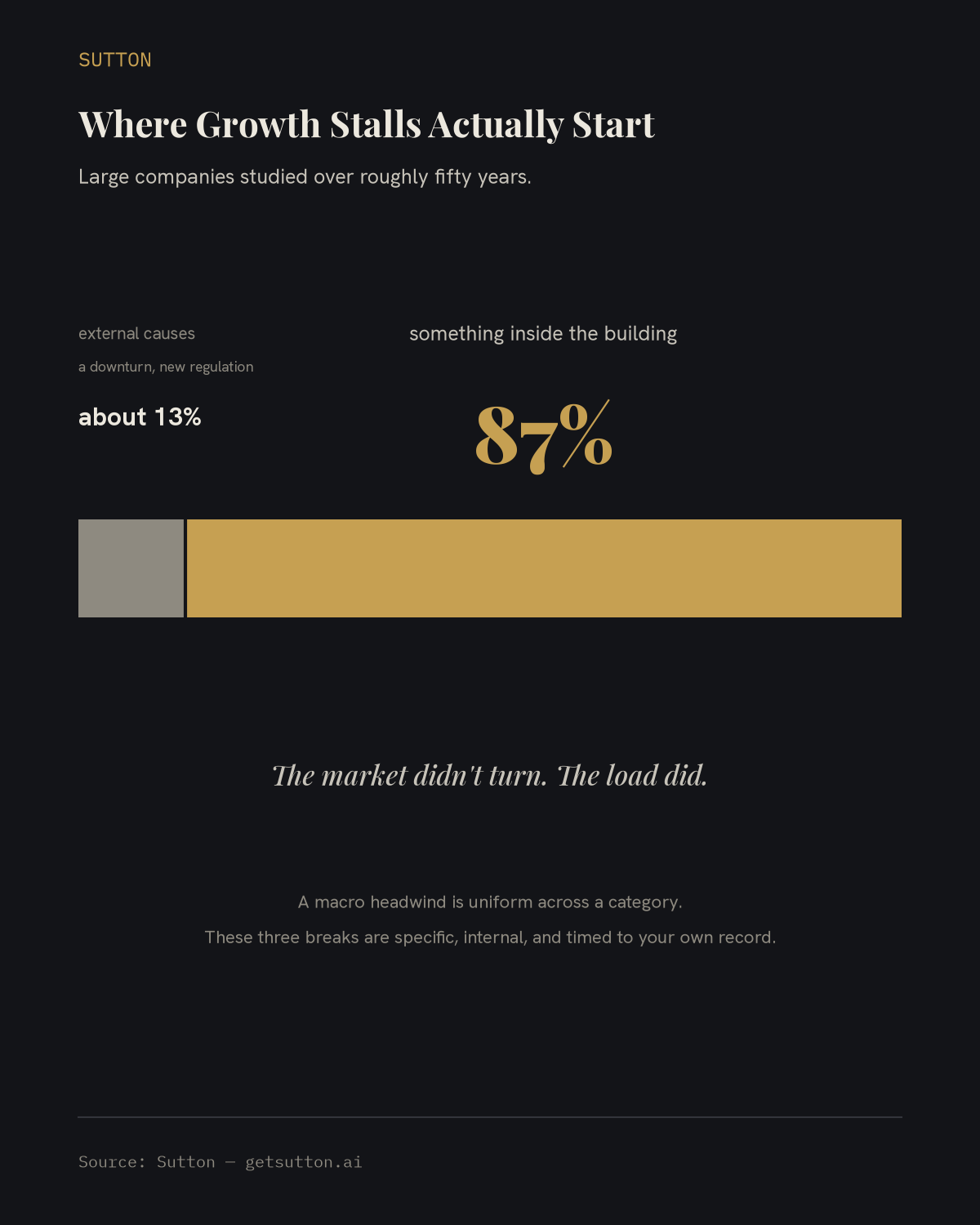
But the record argues against blaming the market alone. Across large companies studied over roughly fifty years, only about 13% of growth stalls trace to external causes like a downturn or new regulation. The other 87% trace to something inside the building. And there is a diagnostic tell, no new dashboard required: if it were purely the market, competitors spending at your level would be flat too, uniformly, all at once. What you see instead is a vacation-shaped dip, a review staffed by someone new, a dashboard that stopped matching the bank, all three landing in the quarter your growth peaked. A macro headwind is uniform across a category. These three breaks are specific, internal, and timed to your own record.
Then comes the practical objection: so the fix is a better agency, a senior hire, and a real attribution setup. Three line items, done by next quarter. Except each fix, bought separately, recreates the original problem. The senior hire becomes the next single point of failure the day they take a vacation of their own. The new agency carries the same percentage-of-spend incentive, just with a nicer deck. The attribution tool is a fourth dashboard grading its own homework. The breaks compound because they are coupled, not stacked side by side. A person hides gaps the agency should be closing. An agency has no incentive to admit the number is wrong. Uncoupled fixes cannot resolve a coupled failure.
What actually changes.
If the three breaks are coupled, getting unstuck isn't a hiring problem or a vendor swap. It is coordination work: one party aligned on your result instead of your spend, who sees the whole funnel at once instead of one slice reported by whoever owns it.
That is, plainly, what Sutton is built to be. Not a fourth purchase stacked on the other three, but the thing that makes them talk to each other. The judgment behind it comes from the $150M in DTC sales driving 6 exits across our founding team, encoded into one operator that runs the whole funnel. One compounding brain across your whole funnel is worth more in month twelve than month one, because nothing re-onboards and knowledge doesn't leak out the sides.
Back to the all-hands.
Picture the same growth leader, same flat chart, six months later. The instinct to blame the market is gone. What she sees now isn't one bad quarter. It is three gauges, and she can name each: the calendar dip, the review staffing, the dashboard that stopped agreeing with the bank. She points at all three, not to explain away the stall, but because naming them is what makes them fixable. Nobody reaches for iOS this time.
The market didn't turn. The load did. Now she knows the difference, and that is the whole game.