Fees & Incentives
The Fee Model Is an Incentive Decision, Not a Price Decision
You have sat in this room.
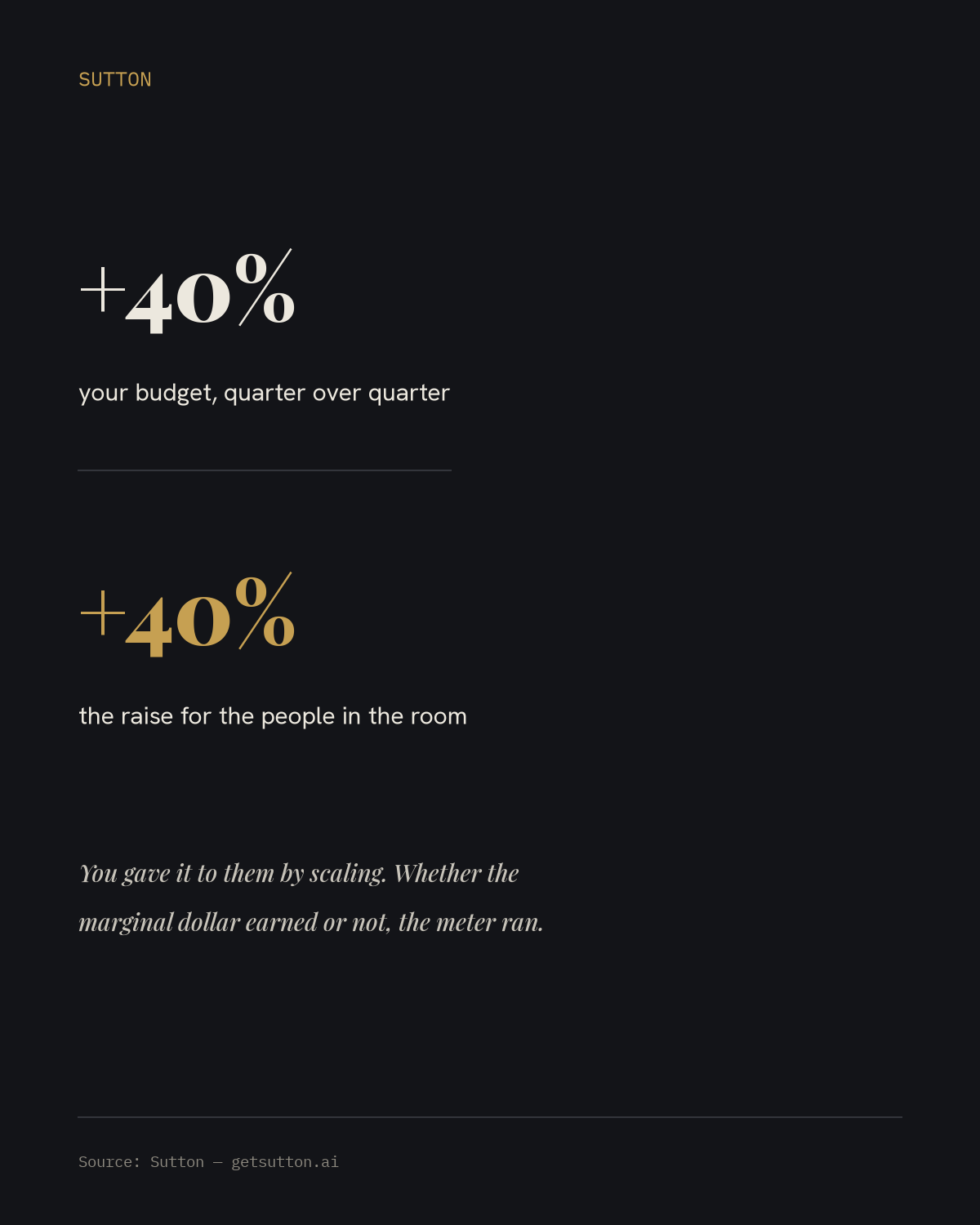
You have sat in this room. The deck opens on a graph sloping up and to the right. Spend is up 40% quarter over quarter. The account manager reads the headline with the practiced enthusiasm of someone who has given this presentation many times. And somewhere in the third slide, while your eye is still on the trendline, you are doing a different calculation in the margin.
If the fee is a percentage of spend, a 40% increase in your budget is a 40% raise for the people in this room. You gave it to them by scaling. Whether the marginal dollar earned or not, the meter ran. Their quarterly result and your quarterly result are not the same number. They only look that way when everything is working.
That is the one question that matters when you compare a fixed monthly fee against a percentage of ad spend: not which costs more in year one, but who the person spending your money is structurally paid to serve. The fee model is not a price. It is an incentive design, and it decides whether the advice you receive is pointed at your budget or your return.
What Each Model Is Actually Charging You For
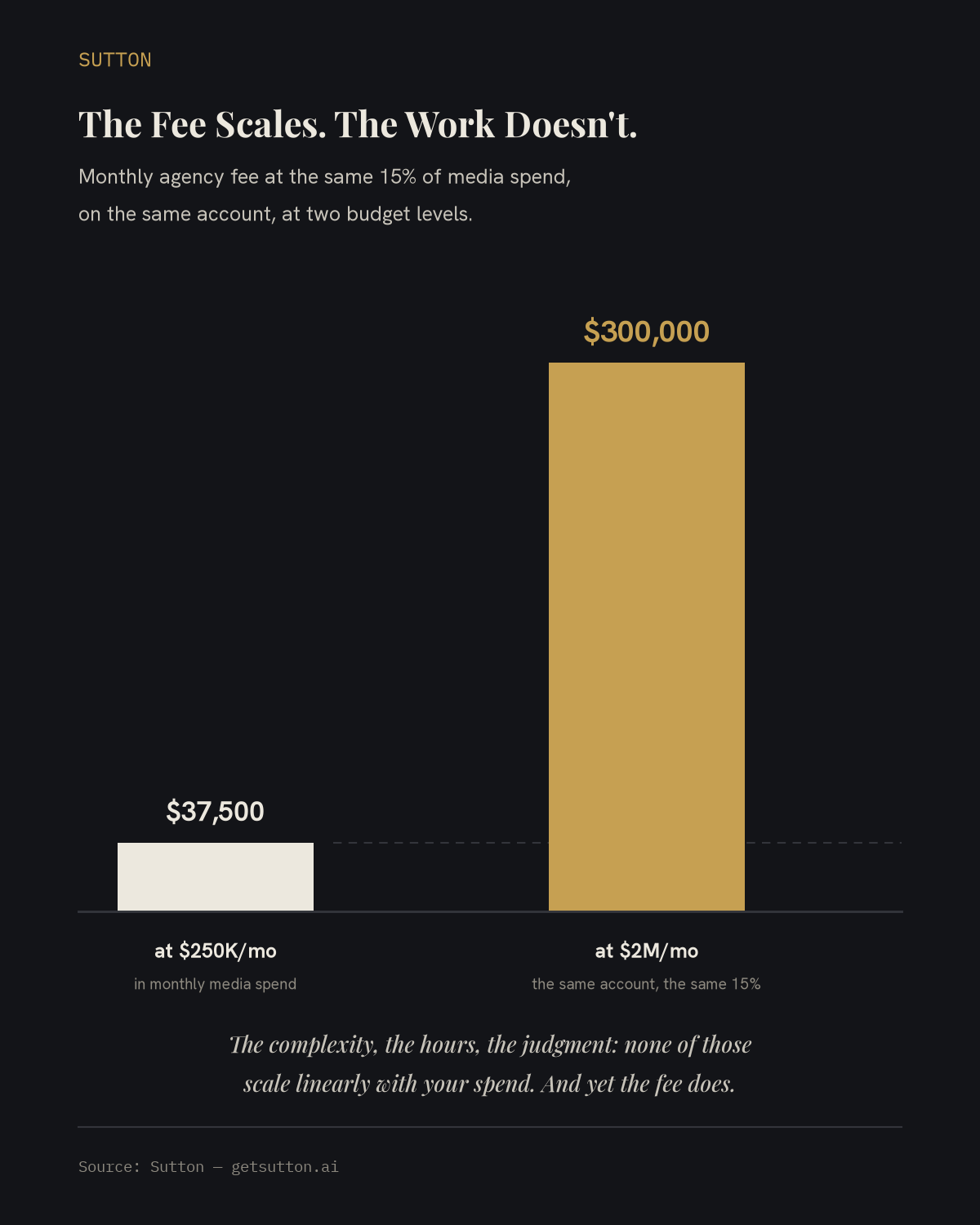
A percentage of spend rises with your budget. That is its only mechanism. At 15% of monthly media, an account running $250K/mo costs you $37,500 in fees. That same account at $2M/mo costs you $300,000. The complexity of the account, the hours of real work, the quality of judgment applied: none of those scale linearly with your spend, and yet the fee does.
A fixed monthly fee does not move when your budget moves. It is the same whether you scale hard in Q4 or pull back in January to protect margin. The operator on a fixed fee has no structural interest in whether you spend more. Their interest is whether the money you spend works.
When you run a fixed fee vs percentage of spend comparison, most people run it as arithmetic: which is cheaper at my current spend? That is the wrong question. The right one is: at what point does this fee give the person running my media a reason to tell me to slow down, versus a reason to keep going? Under a percentage, that reason is never structural. The fee always grows when you spend more. Under a fixed fee, the constraint disappears from the economics, and the advice about whether to scale or hold stops being a conflict.
How the Percentage Compounds Against You at Scale
The brands where this bites hardest are not the ones running $50K/mo. They are the ones at $1M or $2M, where a percentage at the low end of the market standard is already six figures a month in fees before a single dollar of media is placed.
Run it annually. A brand at $1M/mo in paid media on a 15% structure pays $1.8M a year in agency fees. If spend grows 30% year over year, a real number for a DTC brand in its growth phase, the fee grows 30% too, to $2.34M in year two. Not because the agency hired more senior people. Not because the account got harder. Because the meter ran faster.
The growth leader doing this math is not looking for a cheaper agency. They are noticing that the fee is a tax on scale that compounds whether the scaling is working or not.
Nik Sharma of Sharma Brands put it plainly from the operator-peer seat: "their incentives are aligned around spending the most money they can." That is not an accusation. It is a structural description. The agency cannot tell you to slow down without telling you to reduce its own income. The structure makes the honest advice expensive to give.
Olivia at Haus, which sits in the measurement-and-attribution seat, confirmed it from the neutral position: "agencies are mostly billing on percent of spend, and they have no incentive to tell or suggest to a brand that they slow down." The problem is visible from every seat in the room.
The Market Already Repriced the Work, and the Agencies Said So
Here is what makes the percentage-of-spend model harder to defend year by year: the industry has already told you what the work is worth without it.
Taylor Holiday, CEO of Common Thread Collective, described the shift out loud: "We used to charge 10% of spend to manage a Facebook ad account for somebody who's spending a million dollars, now the price is more like $5,000. The underlying service market expectation went from a 100,000 to $5,000."
The work is the same. The platforms are the same. A million-dollar Facebook account is a million-dollar Facebook account. The fee structure changed, and by his own account the price of the same work collapsed. That is not a margin story. It is a signal that the percentage was never tied to the value of the management.
And the shift is not one agency's candor. Across the industry, fixed-fee and hybrid arrangements have been displacing pure percentage-of-spend as the default compensation model, and the percentage structure has been losing ground as the standard for years. The direction of travel is away from a fee that rides your budget.
The model also has a specific origin. The commission began in the 19th century, when advertising agents were paid by publishers to place space: the publisher was the principal, and the agent's incentive was correctly aligned with placing more, because placing more was the whole job. The structure survived for nearly a century after agents switched sides to represent advertisers. The incentive was never updated for the side change. What you pay under today is a holdover from a time when the agency was paid by the media company to spend your money, not by you to make it work.
The Objection: Doesn't a Percentage Align the Agency With Your Growth?
The strongest version of the counter is worth taking seriously. On a percentage of spend, the agency only wins if you scale. So when things are working and you want to push, the agency has every reason to back you. You are aligned.
The problem is the direction. You are aligned on the way up. You are misaligned on the plateau and on the way down. The percentage rises every time spend rises, regardless of what return the extra spend generates. If you are at $1M/mo and your marginal ROAS on the next $100K sits below your contribution-margin threshold, the percentage fee gives the agency no structural reason to flag it. The metric they are paid on is spend. Your metric is MER.
Spend and return overlap when everything works. They diverge exactly when discipline matters most: when scale stops working at the margin, when a channel softens, when you need to hold rather than push. The percentage model does not distinguish those moments. It charges the same rate whether or not the advice to keep spending is in your interest.
The second counter is fair too: a flat retainer can mean you overpay at low spend and the agency coasts at high spend with no accountability. That is a real failure mode, and the fee structure alone does not solve it. A fixed fee without a grading commitment is just a different misalignment. What makes a fixed fee work is measurement on the client's own numbers, GA4 and MER, not the platform's self-reported figures. The answer to the coasting retainer is not the percentage. It is measurement. Fix the accountability, not the fee direction.
Compare Like a CFO on Your Own Numbers
The practical move is arithmetic, not theory. Take your current monthly paid media spend. Apply the low and high end of the market standard, 10 to 20%, for the annual fee range under a percentage structure. Compare that against what a fixed monthly retainer costs over the same period. Then ask which grading axis comes with each: does the model reconcile against your own GA4 and MER, or against the platform's self-reported ROAS?
Every ad platform grades its own homework and gives itself an A+. "When Meta says ROAS is 4x and your P&L says you lost money, your P&L is right." That line, from DTC growth consultant Curtis Howland, is the attribution problem in one sentence. The platform number is not lying in the statistical sense. It is measuring something other than what lands in your contribution margin. MER and nCAC are the metrics an attribution window cannot game.
So when you model the two structures, you are not asking which is cheaper. You are asking which is graded on the number your CFO believes, and which one rises when you spend more regardless of what that spending is doing to your margin. That reframe changes the comparison. It stops being a pricing negotiation and becomes a decision about what behavior you are paying to reward.
The Meeting, Differently
Imagine the same QBR, different structure. The deck opens on the same graph. Spend is up 40%. But the person presenting earned the same this quarter no matter what that number said, because the fee was fixed in the contract. So the next slide is not about spend. It is about what the spend returned, modeled against your real MER and checked against your own GA4.
If the 40% worked, that is the story. If part of it did not, that is also the story, told by someone with no structural reason to hide it. Advice from a fixed-fee operator is not contaminated by a meter that runs faster every time the answer is "spend more."
That is the version of the meeting that becomes possible when the fee model is an incentive decision, not a price decision.
We built Sutton on that structure: a fixed monthly fee, no percentage of your ad spend, ever. The judgment doing the work is the encoded record behind it: $150M in DTC sales driving 6 exits across our founding team. The grading runs against your own numbers, not the platform's, and every dollar of live media waits on your approval before it spends.
The incentive is result-per-dollar, not volume. That is not a discount. It is alignment. And it is the one question worth asking before the next QBR.