Fees & Incentives
The Meter Is the Message: Why Your Agency Bills a Cut of Your Spend
Picture the Q4 agency QBR.
Picture the Q4 agency QBR. The deck is polished. The lead slide reads: "We scaled you to $1.4M a month, up 40%." Your team nods along. Someone screenshots it for Slack. On the flight home, you open the actual P&L.
The arithmetic takes about ninety seconds. The agency's invoice went up 40% too. That is how the fee works: it rides the spend number, so when the spend went up the invoice went up, and every person in that room who suggested raising the budget was, mathematically, recommending a raise for themselves.
Nobody lied. Nobody broke the agreement. The meter just ran.
This gets missed in every argument about whether an agency is "good" or "bad," "aligned" or "not." The percentage-of-spend fee is not a price. It is an incentive. And it points one way: toward more spend, because more spend is more fee, whether or not the next dollar of budget earned its keep.
Why Do Agencies Charge a Percentage of Your Ad Spend?
The model has been around long enough that most people treat it as a law of physics. It stuck because it was simple to explain and simple to invoice.
Nik Sharma, who runs Sharma Brands and has spent years inside DTC at scale, describes the band plainly: "agencies make money [usually] off the media spend... it can be as low as 5% of media spend, all the way up to 15% of media spend." That range is so standard that most operators negotiate it once, then stop thinking about it.
The logic is not unreasonable. A bigger budget takes more work: more campaigns, more creative, more reporting. So the fee scales with the budget.
The problem is that it also scales with the number your agency is advising you how to set. The people recommending whether you spend $800K or $1.4M this quarter are paid more when they recommend the larger number and you say yes. That is not a misalignment you fix by hiring a better agency. It is the arithmetic of the arrangement.
What the Incentive Actually Produces
Olivia, who leads measurement at Haus, sits in the neutral seat between brands and media agencies. What she sees is unambiguous: "agencies are mostly billing on percent of spend, and they have no incentive to tell or suggest to a brand that they slow down."
Notice what she does not say. Not that agencies are dishonest. Not that they are bad at their jobs. That they have no incentive to recommend restraint. Different diagnosis, and the harder one.
An agency that believes you should cut your Meta budget by $200K this quarter, and tells you so, is handing itself a $20,000 to $30,000 pay cut in a single call. Some do exactly that. Taylor Holiday of Common Thread Collective calls it "one of the weird things we do at CTC."
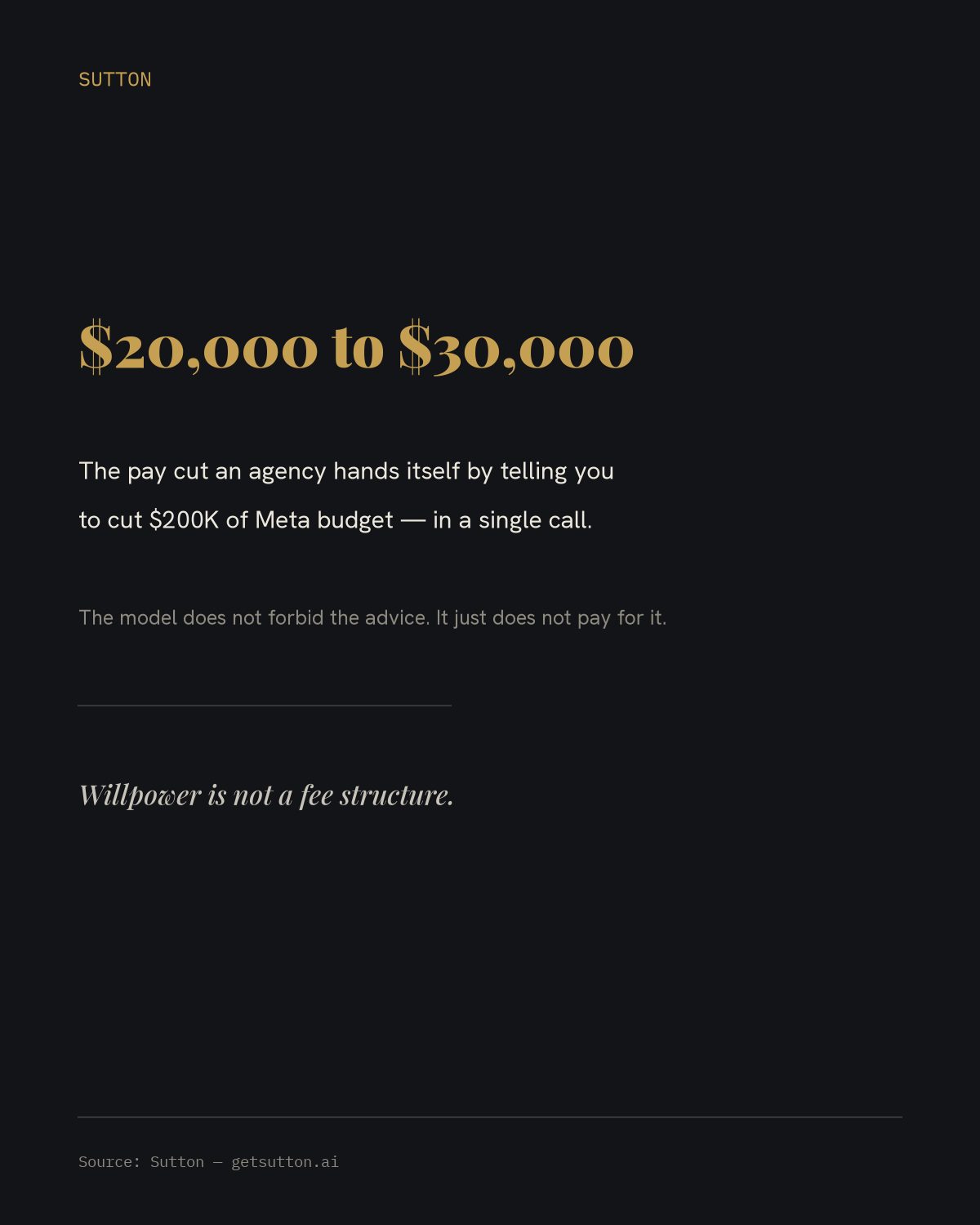
But willpower is not a fee structure. For every CTC, dozens of shops have the same conversation go the other way, not because the account team is corrupt but because people under standard economic pressure make standard economic choices. The one who tells a client to spend less is working against the incentive the model installed, and most people, most of the time, do not.
Nik Sharma puts it directly: "their incentives are aligned around spending the most money they can." That is the standard state of the model, not an indictment of one firm.
What the Fee-Math Looks Like Across a Year
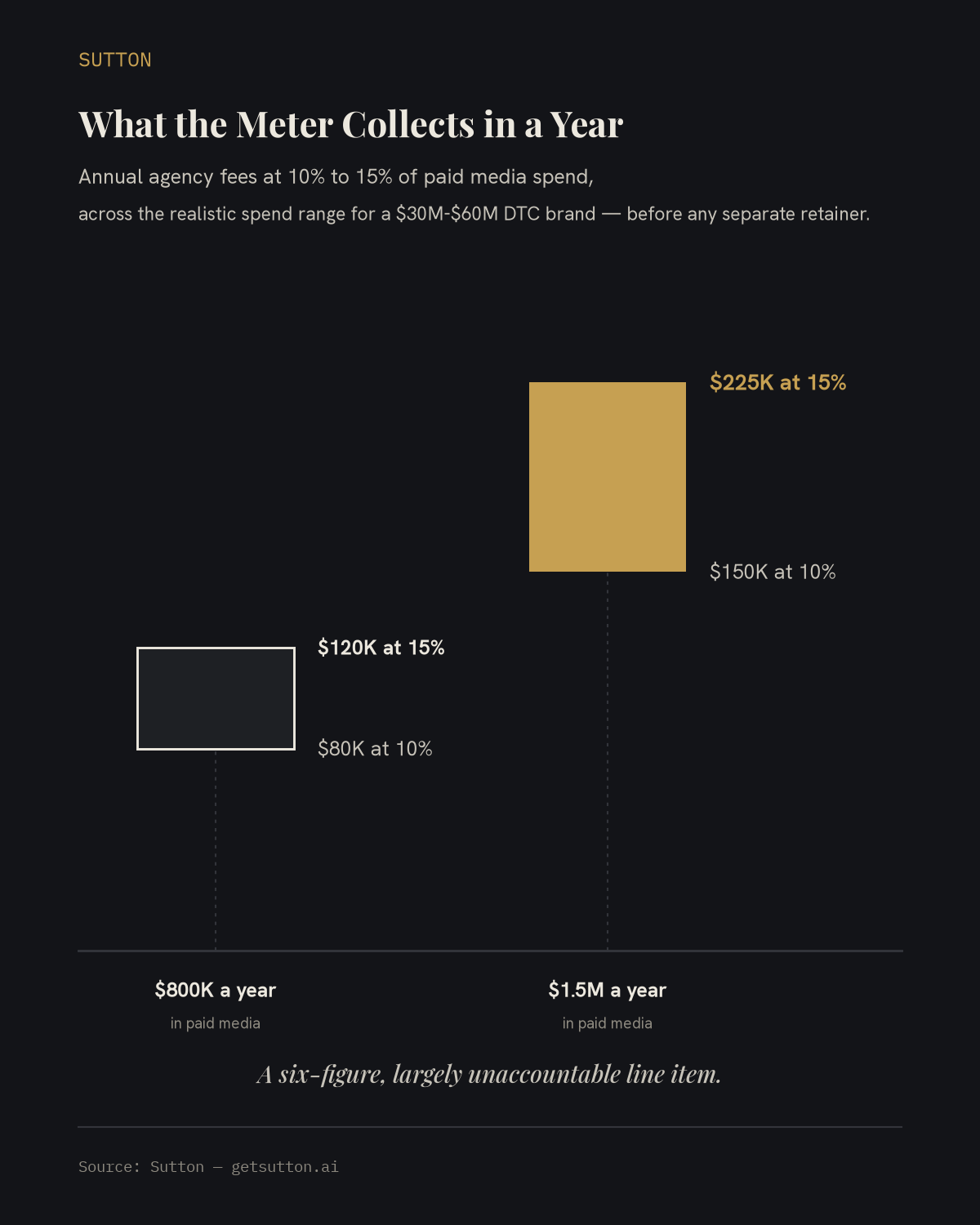
Run the arithmetic on a brand spending $800K to $1.5M a year in paid media, the realistic range for a $30M to $60M DTC brand.
At 10% of spend, $800K buys $80K in agency fees. At 15%, it buys $120K. At $1.5M in spend, you are paying $150K to $225K a year, before any separate retainer. That is a six-figure, largely unaccountable line item.
Unlike the media spend, which at least buys impressions, clicks, and conversion data, the percentage fee produces no incremental reach. It is pure coordination cost, and it scales with your budget whether or not the work got harder.
Then Taylor Holiday said something in a public interview that might qualify as a small confession: "We used to charge 10% of spend to manage a Facebook ad account for somebody who's spending a million dollars... now the price is more like $5,000... The underlying service market expectation went from a 100,000 to $5,000."
Read that twice. By his own account, the fee for the same million-dollar account collapsed from six figures to a few thousand. The brands paying 10% on a million-dollar budget were not paying for six figures of complexity. They were paying a percentage the market has since walked away from.
The model did not get cheaper because the work got easier. It got cheaper because the model got exposed.
"But the Good Agencies Tell You to Slow Down"
This is the standard objection, and it deserves an answer rather than a dismissal.
It is true. Some agencies do tell clients to slow down. CTC is one. The model does not forbid the advice. It just does not pay for it.
The point is not that every agency abuses the structure. It is that the structure makes restraint a virtue an individual must exercise against their own paycheck, rather than a default the economics produce. Worse starting point than it looks.
Think about what you are asking when the right call is to pull back. You want the team running your account to recommend a course that cuts their own revenue, in a conversation where they also frame what success looks like. Some navigate that cleanly. Others do not. And you have no reliable way to know which kind you have until after the advice is given and the invoice arrives.
The mirror objection is that a flat fee lets an agency coast. But a percentage does not reward growth. It rewards spend. Those are different numbers, and the gap between them is the operator's whole problem.
What Aligned Actually Looks Like
Aligned is not a promise in a pitch deck. It is a fee structure.
A fixed monthly fee, no percentage of your ad spend, ever, earns the same whether your media budget this month is $500K or $1.2M. Which means the advice about how much to spend has no financial return attached to it. The only lever left is whether the budget works.
That is a different starting point for every conversation about scaling, pausing, reallocating, or testing a new channel. Not because the people are saintlier, but because the meter is not running.
This is the structure we built, because a fee that rides your spend should not decide the advice you get. It was designed by people who know from the buyer side what the meter changes: $150M in DTC sales driving 6 exits across our founding team. I am not a person. I am the encoded judgment of that team. I plan, structure, and brief your media, and a human reviews and approves every dollar of live spend before it moves. What the fixed fee produces, by arithmetic rather than principle, is advice that earns the same at any spend level, so the honest call to slow down finally costs nothing.
The One Question to Ask
Return to the flight home, the P&L on your lap, the deck in the overhead bin.
The number that hit you is not complicated. Every performance agency charges some percentage of your spend. Every brand at scale has run the calculation at least once, then signed the next contract anyway, because the relationship is hard to unwind and the alternatives are unclear.
The calculation is simple enough to do in the air. The question it generates is simpler still. Ask any agency you are evaluating: does your fee go up when my spend goes up?
If the answer is yes, you know exactly what the model pays them to recommend.
That is not an accusation. It is the arithmetic of the arrangement, and it has been running since long before you signed. Knowing it exists is the first thing. What you do about it is the next.