Agency vs In-House
The In-Housing Playbook Nobody Writes: What to Own, What to Delegate, and Why Running It Yourself First Changes Everything
Connor MacDonald is staring at an invoice.

Connor MacDonald is staring at an invoice.
Ridge's marketing is almost entirely in-house now: creative, strategy, most of the media already inside the building. What's left are the retainers going out the door to the buy-spend agencies running the last slice of paid. MacDonald is doing the math the way operators actually do it. Not in a strategy offsite with a consultant's logo on the slide. At his desk, looking at a number that used to make sense and doesn't anymore.
"We should hire two more creative strategists, a fraction of the cost, but probably better quality."
That's the sentence. Not a manifesto about ownership. A cost comparison that happens to double as a strategy decision. This is where in-housing actually gets decided: in a spreadsheet, staring at a fee that no longer justifies itself.
Most of what gets written about in-housing stops right there, at the math. Agency versus in-house. Cost versus control. Speed versus specialization. Pick a side, argue it, move on. Tidy, and useless to the operator holding the invoice, because the real question was never which side to pick. It's what to do next, in what order, and who you trust with the parts you don't do yourself.
In-housing isn't a decision. It's a sequence. The brands that get it right run each function themselves before they hire anyone to run it, so they hire against a process they understand instead of guessing at one from a job template. Run it honestly, all the way through, and it lands somewhere the agency-versus-in-house framing can't reach: not a rip-and-replace, but a hybrid, where you own the thinking and delegate the commodity.
What to Bring In-House First (and What Not To)
Not every function pays off equally from being owned, and MacDonald's own team is proof of the pattern before it's proof of the argument. Ridge kept creative and strategy inside first. Those are the functions where knowing the brand changes the output: a strategist who has sat in the customer research calls writes a different brief than one who hasn't, and the account's memory of what worked in March is still in the room in September. Those functions compound. The longer you own them, the more they're worth.
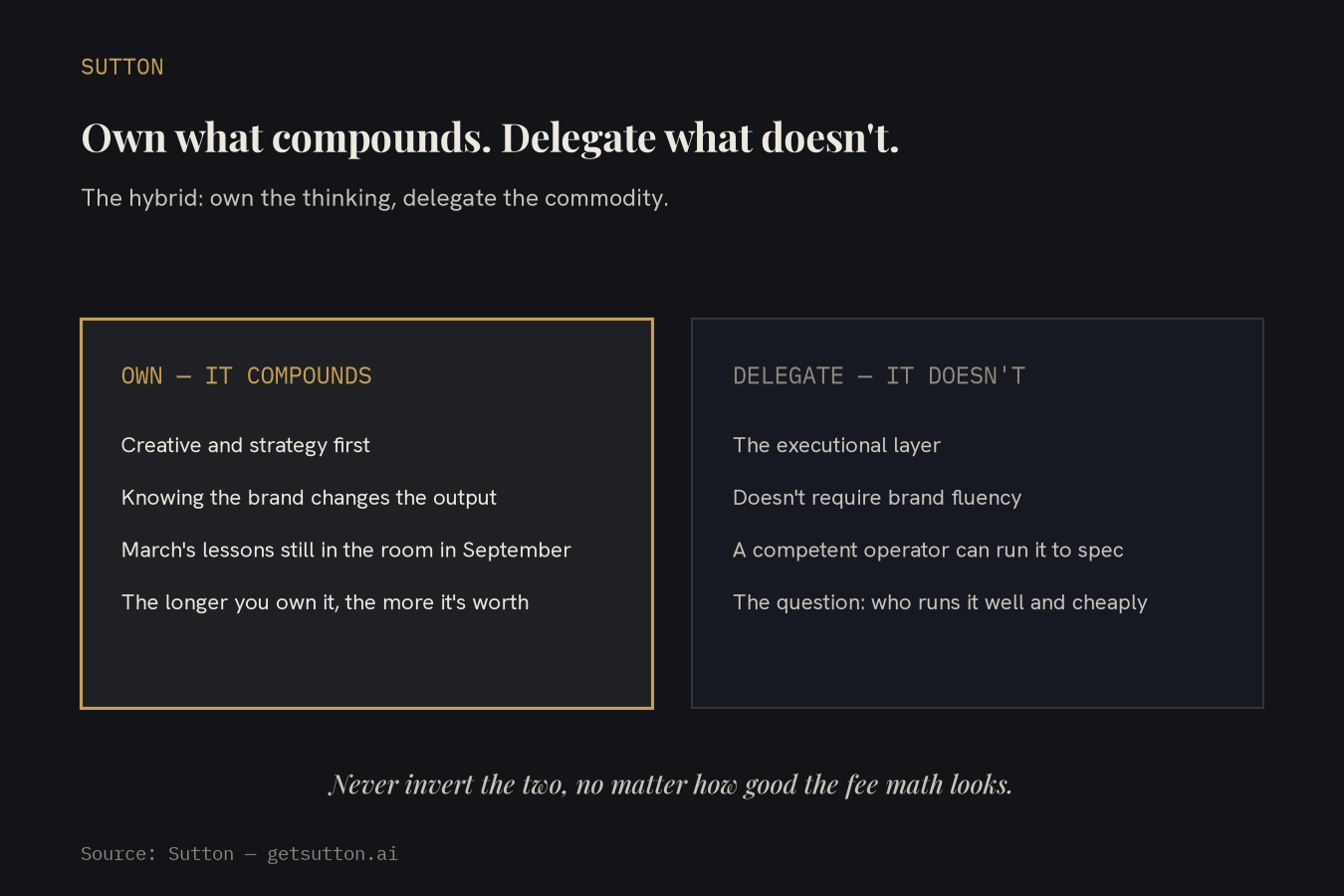
What's left outside is the executional layer, the part that doesn't require brand fluency, that a competent operator can run to spec once the strategy is set. Keeping it external isn't a moral failing. It's the correct read of which parts of the work get better with brand context and which parts just get done.
The mistake isn't bringing marketing in-house. It's bringing all of it in-house, all at once, on the theory that ownership beats delegation by default. It doesn't. Ownership wins where knowing the brand is the whole job. For everything else, the question is who runs it well and cheaply, not who runs it under your roof.
Run It Yourself for a Month Before You Hire Anyone
Cody Plofker runs growth at Jones Road Beauty, and his method for taking a function in-house has nothing to do with org charts. "Run this myself for a month, and then iron out the kinks, and then hand it off."
That's the step almost nobody writes about, because almost nobody writing about in-housing has done it. Arguing the merits of owning a function from the outside is easy. Sitting inside it for thirty days, hitting the parts of the workflow that don't work, and fixing them before you hand your mess to someone else is another thing entirely.
Run a function yourself first and you learn where the real levers are, not the ones printed on the job description. What the weekly cadence should be, what the reporting actually needs to say, what breaks when volume doubles, which vendor relationship is load-bearing and which one is dead weight you inherited. None of that shows up in a hiring brief written by someone who has only managed the function from a distance.
Then you hire. Not against a guess at what the role should look like, but against a process you built and stress-tested yourself. The candidate isn't inheriting an abstraction. They're inheriting a system you know works, because you're the one who broke it and fixed it first.
Skip that step and you're hiring blind: writing a job description for a function you've never run, interviewing for skills you can't evaluate, hoping the person figures out the role faster than you could have. Sometimes they do. That isn't a strategy.
Hire for Judgment, Never for Grunt Work
Plofker learned the inverse the hard way. "I had senior growth people who were uploading ads. You should be getting that off your plate to spend time on the higher-leverage things."
That's the failure mode on the other side of in-housing done badly. You build the team, then let its most expensive people spend the week on the part of the job that doesn't need their judgment. A senior strategist uploading creative into an ad platform isn't an in-house win. It's an agency's org-chart problem, imported and repriced at a higher salary.
The fix is a discipline, not a headcount decision: hire for judgment, and systematize or delegate everything commodity underneath it. The person you bring in-house should spend the week on the calls that require reading the account and knowing the brand, not on execution any competent operator could run to spec.
None of that works without a source of truth you trust. You can't grade a team, an agency, or yourself on a number that's grading its own homework. Platform-reported ROAS is the ad platform telling you how well the ad platform did. The number that matters is on your own P&L, which for a scaled brand means GA4 and MER, not the dashboard the platform hands you. Build the team without that measurement backbone and you've built a team you can't evaluate. You're back where you started: guessing.
The Objection, and Why It's Half Right
The obvious counter is MacDonald's own math, taken to its conclusion. If the agency fee no longer justifies itself for creative, why not for everything? Bring the whole funnel in-house. Same logic, run further.
It's half right. The math holds for functions where brand fluency compounds. It breaks the moment you apply it to commodity execution, because in-housing the part that doesn't need brand context doesn't make it more strategic. It just moves the senior-people-uploading-ads problem inside your own walls, at your own payroll cost.
The gentler version: just hire one great senior growth lead and let them build the function. One excellent operator, the theory goes, can stand up everything. Except a single senior hire is a single point of failure, capped by one person's hours and one person's judgment, and if you haven't run the function yourself first, you're hiring against a job you can't evaluate. The run-it-yourself step isn't busywork. It's what makes the hire legible in the first place.
Own what compounds. Delegate what doesn't. Never invert the two, no matter how good the fee math looks on the function you're least equipped to run yourself.
The Honest Answer Is a Hybrid
Run the sequence all the way through and most $30M+ brands land in the same place: own the thinking, in-house what compounds, delegate the rest to whoever runs it best. That's the answer nobody wants to write, because it doesn't fit in a headline. "Bring everything in-house" and "fire your agency" both sell better than "it depends, and here's how to tell."
The delegate layer is where this stops being an org-chart question and becomes a question of who you trust with the rest. Not every "rest" is equal. An agency paid a percentage of your spend is incentivized by your spend, not by your result. That's the reason we built Sutton as the other kind of partner: a fixed monthly fee, no percentage of your ad spend, ever, so the incentive runs toward making your money work rather than growing the bill. And because it's one brain across your whole funnel instead of a rotating cast of account managers, it compounds. What it knows about your brand in month twelve is worth more than what it knew in month one, because nothing re-onboards.
That's not an argument for skipping the sequence. It's what the sequence is for. Run each function yourself first, learn what actually needs owning, and you know exactly what you're delegating and why, instead of outsourcing by default because hiring felt too hard.
The Invoice, Again
MacDonald is still looking at that number. By the time you've run the sequence, though, the invoice reads differently. It was never really an agency-or-in-house question. It was a question about which parts of the job get better because you own them, and who you trust with the parts that don't.
Two more creative strategists, a fraction of the cost, probably better quality. That's not the end of the in-housing story. It's the first right answer inside a longer one: know what to own, run it yourself before you hand it off, and delegate the rest to someone whose incentives point the same way as yours.