AI Marketing Agency for Ecommerce: How to Tell the Real Ones From the Rebrands

The deck is the same deck as last quarter.
Same senior partner presenting, same junior running the account in the background, same 4x reported ROAS the P&L keeps contradicting. The quarterly business review is forty minutes in, and the Head of Growth across the table has a question she does not ask out loud: if the platform says 4x and my CFO sees a loss, who do I believe?
Then she notices the title slide. It reads "AI-Powered Performance." Nobody in the room can tell her what the AI actually does. The invoice, a retainer plus a percentage of everything she spends, has not moved a cent.
She has just witnessed the cheapest rebrand in the history of marketing services. Adding "AI-powered" to the deck costs nothing. Changing the fee structure costs everything.
The label tells you nothing. The structure underneath it tells you everything. There are three questions a real structural shift cannot avoid, while a cosmetic rebrand cannot survive.
---
Question One: How Do You Get Paid?
This is the only question that cannot be gamed in a pitch. It lives in the contract.
A performance agency's economics have not changed in twenty years: a monthly retainer plus a cut of ad spend, commonly 10 to 20 percent of media. On a brand running $500,000 a month in paid media, that cut is $50,000 to $100,000, recurring, and it grows every single time you are advised to spend more. As Olivia at Haus, a measurement firm with no skin in the outcome, put it: "agencies are mostly billing on percent of spend, and they have no incentive to tell or suggest to a brand that they slow down."
That is not an accusation. It is arithmetic. The incentive points at volume, not at result-per-dollar.
A fixed monthly fee with no percentage of ad spend, ever, is not a discount. It is a different interest. If the fee does not grow when the budget grows, the only thing left to optimize is whether your money works.
Run this question first, and run it against the contract, not the pitch. A firm still taking a percentage of spend cannot pass it, no matter how it phrases the AI. The invoice is the tell.
---
Question Two: Does the Intelligence Compound?
Most agency engagements re-onboard.
A new brief, a new relationship manager, a new round of explaining what you tried before and why it failed. The relationship restarts from close to zero every 12 to 18 months. Knowledge does not port. The context about your customers, your seasonal patterns, your margin structure, and your creative track record walks out the door with the team that built it.
One compounding brain across your whole funnel is worth more in month 12 than in month 1, because nothing re-onboards and knowledge does not leak out the sides. This is not a promise about performance. It is a claim about architecture. A human team is subject to turnover and drift. A single persistent intelligence accumulates without the forgetting.
The test is specific: after twelve months, does your operating partner know more about your brand than it did in month one, or does it know roughly what it would have known if it had read the onboarding deck carefully? Re-onboarding is expensive not just in time. It is expensive in the compounded knowledge you never built.
---
Question Three: Who Is Accountable When a Dollar of Live Spend Moves?
Connor MacDonald, CMO at Ridge, ran a real test. He described it plainly: "We tried a tool like this last year, automated media buying, and it was really hard to say if it outperformed or underperformed having a real person run the account."
That is the honest answer, and the right place to start. Automated media buying without a review gate produces a result that is, by design, ungradeable. Not because the result is bad, but because accountability is the prerequisite for knowing what the result means.
The human gate is not a hedge on AI capability. It is what makes the outcome legible. An AI that plans, diagnoses, structures, and briefs your paid media, with a human review gate that activates live spend, is a different instrument than an AI left to move budget on its own. The approval step is not a limitation on the model. It is what makes the model's work auditable.
Matt Bertulli, CEO of Pela and Lomi, framed the operator instinct: "This is not a moment to just assign an AI person and then hope that they do it. You need to know how this works." Every serious operator at a serious budget echoes some version of this. The human needs to be on the hook.
The honest answer to question three is a human review gate that approves every dollar of live spend before it moves. Not autonomous. Not hands-off. The accountability is visible and it is structural.
---
The Objection Worth Taking Seriously
Any firm that wants your business will answer these three questions the way you want to hear.
Fixed fee? We can price that. Compounding intelligence? Our AI learns over time. Human gate? Of course someone approves the big decisions.
The fee question is the hardest to fake, because it is structural and it is checkable on the invoice. A firm still billing on a percentage of spend cannot pass it, whatever it says in the deck. The others require judgment. Ask what the compounding looks like in practice: what does month-12 knowledge look like versus month-1, concretely? Ask exactly who approves what before a dollar moves: the answer should name a person and a process, not a principle.
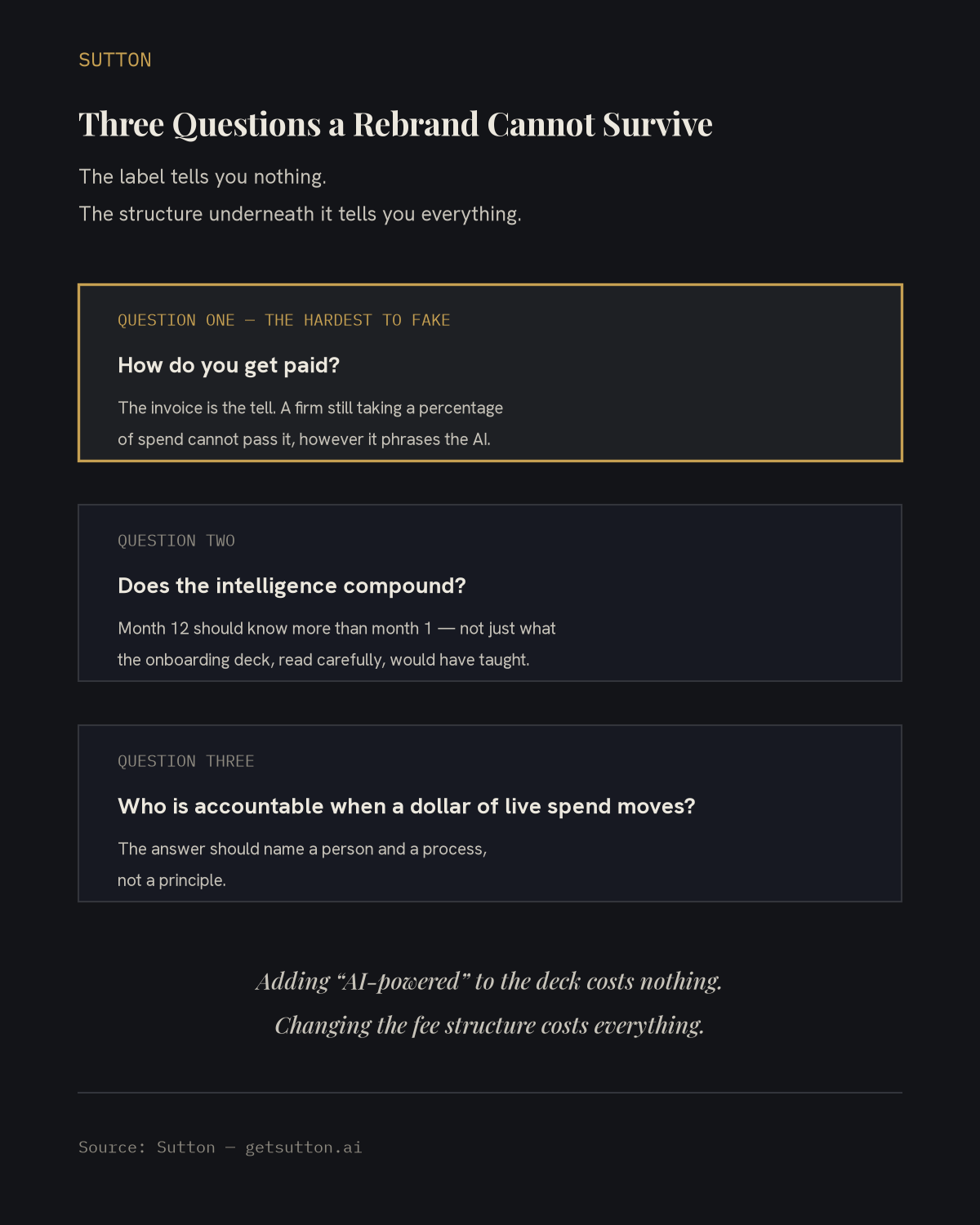
The three questions are not a checklist you run once. They are a lens you apply to the contract, the invoice, and the operating model.
---
What the Three Questions Reveal
Run them with discipline and most "AI marketing agencies for ecommerce" resolve quickly. The percentage-of-spend model is still there, the re-onboarding is still there, and the accountability for live spend is vague enough to dissolve if a quarter goes wrong.
What is left is a small category: firms whose fee structure is genuinely fixed, whose intelligence genuinely accumulates, and whose human gate is genuinely structural. The honest label for that, at a $30M+ brand, is an operating partner with a point of view, not an agency with an AI wrapper.
This is the category we had to build, because a rebranded agency cannot pass its own three questions. Sutton is an AI with the encoded judgment of the team that did $150M in DTC sales driving 6 exits across our founding team, running on a fixed monthly fee with no percentage of your ad spend, ever, graded against your own GA4 and MER, the numbers your CFO believes, not the platform's self-reported ROAS. We make the expensive mistakes on our own money first. Every dollar of live spend is human-gated before it moves.
That is not a pitch. It is a structural fact, and it survives the three questions you just read.
---
Take the Three Questions Into the Room
The next time an agency shows up with "AI-Powered" on the title slide, the QBR is an opportunity rather than an obligation. The checklist is short.
Question one: Show me the fee structure in the contract. Is there a percentage of ad spend anywhere in the invoice?
Question two: If I pulled the onboarding brief from month one and the work product from month twelve, what would the intelligence have compounded into that was not there at the start?
Question three: Walk me through exactly what happens before a dollar of live spend moves. Who approves it, and what is the process?
The deck that cannot answer all three clearly is not an AI marketing agency for ecommerce. It is an agency that added four words to the title slide.
The test is yours now. Use it.