The One Question That Sorts Every Media-Buying Agency (And Why the "Best Of" List Won't)
The slides are clean. Four-x platform ROAS. The account is "scaling nicely." The recommendation: increase budget.
She nods. She has heard this before. While the account manager clicks to the next slide, she opens another tab: GA4, then her blended MER. The last two months of added spend barely moved the number her CFO watches. The agency's invoice, meanwhile, went up on its own, because it is a percentage of a budget it just told her to raise.
Nobody in that room lied. The incentive did the talking.
This is the scene playing out in quarterly business reviews at $30M+ DTC brands everywhere: a reported number that looks healthy, a P&L that disagrees, and a fee structure that makes the two perfectly compatible from the agency's side. The agency is not corrupt. It is paid to want more of what it recommends.
The "best media-buying agency" list does not fix this. Neither does the one with the longer case study deck. There is no best agency, only a best-fit one, and the fastest way to sort the field is not a ranking. It is one question.
The Wrong Artifact
Type "best media-buying agency for DTC" into a search bar and you get ranked lists and "top 10" roundups. Some are put together by thoughtful editors. Some are quietly paid for by the firms on them.
None of them can tell you whether a given agency is right for your brand at your spend level. A firm that is exceptional for a $5M brand on a single channel may be completely wrong for a $50M brand with three channels, a GA4 setup that needs rebuilding, and a CFO asking hard questions about platform-reported ROAS.
Case studies tell you what an agency can do for somebody. They do not tell you what it is paid to want from you. You do not need a list. You need a test you can run in any pitch meeting.
The One Question
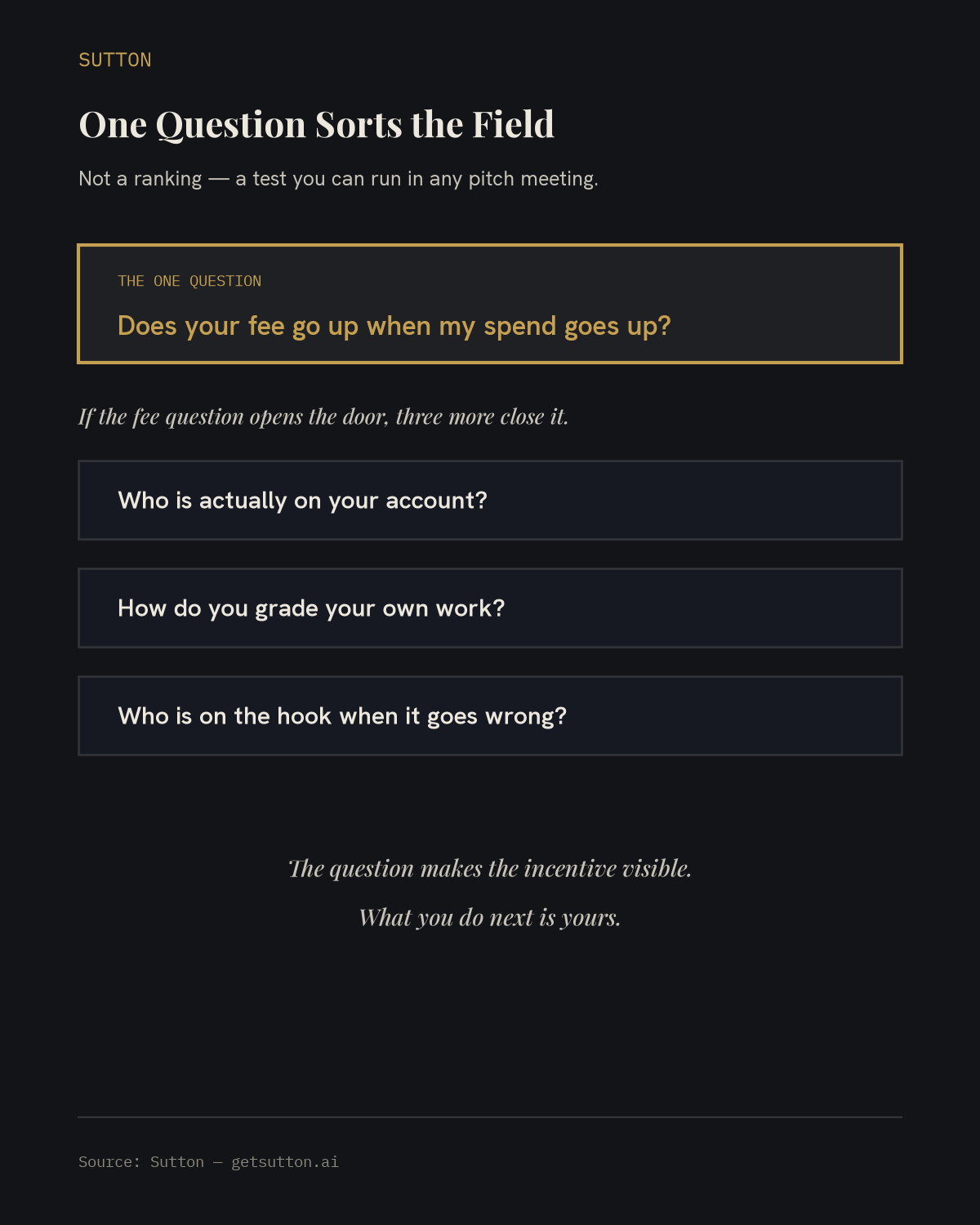
Does your fee go up when my spend goes up?
It sounds too simple. But the answer predicts most of what you actually care about.
A percentage-of-spend model means the agency earns more every time you raise your budget, whether or not the added spend is working. At the headline range of 10-20%, a $1M monthly media budget already generates $100,000 to $200,000 in management fees. Add what lives outside the base scope, creative production, landing pages, ad-tech fees, reporting, and the effective rate climbs well above the headline number.
That is not a scandal. It is a structure. When a budget is working, the agency earns more. When it has stopped working, the agency also earns more, as long as you keep spending.
Olivia, from the attribution firm Haus, put it plainly: "agencies are mostly billing on percent of spend, and they have no incentive to tell or suggest to a brand that they slow down." Nik Sharma of Sharma Brands said the same thing from the operator side: "their incentives are aligned around spending the most money they can."
This is not a criticism of the people inside those agencies. Many are excellent. But no relationship rewrites what a vendor gets paid to want. A fixed fee earns the same at any spend level. The only lever left is whether the budget works.
The Other Three Questions
If the fee question opens the door, three more close it.
Who is actually on your account? Nik Sharma again: "No one is FULLY dedicated to your account." This is the senior-sells, junior-runs problem, endemic to the percentage model because margin comes from the gap between the fee you charge and the labor you allocate. A senior operator sells the relationship; a junior team runs the month-to-month. So ask for the specific people who will run your account, how many other accounts that team carries, and what happens when the lead strategist leaves.
How do you grade your own work? Curtis Howland, a DTC growth consultant, described the measurement problem as cleanly as anyone: "Every platform is grading its own homework. And every platform gives itself an A+."
Meta reports one ROAS. Google reports another. TikTok's reps take credit for the same conversion. For multi-channel brands running all three, the double-counting inflates the apparent performance well beyond what your blended numbers show. Howland again: "When Meta says ROAS is 4x and your P&L says you lost money, your P&L is right." So ask whether the agency grades its work on the platform's self-reported numbers or on your GA4 and your blended MER, the only number a platform can't inflate by taking another's credit. Howland's formulation: "MER and nCAC are the only metrics that can't lie to you." Two agencies looking at the same budget, one grading on platform ROAS and one on your MER, make different decisions. Only one is right.
Who is on the hook when it goes wrong? Luke Austin, VP of ecom strategy at CTC, put the accountability register honestly: "someone's also got to make a judgment call and be on the hook for the outcome." With a serious budget, that accountability has to live somewhere specific. If something goes wrong, who calls you, and what can they actually change?
These four questions do not guarantee you a good agency. They guarantee you have looked at the right things.
The Objections
Two counterarguments come up, and both deserve a real answer.
The first: a good agency on percentage of spend is still worth it, because alignment is about the relationship, not the contract. True about people, beside the point about structure. Plenty of excellent operators work inside the percentage model. But when the budget rises, the fee rises with it, automatically, without anyone deciding. The firm does not have to want the wrong thing; the contract already arranged it.
The second is the honest one: can you even trust an AI with a serious budget? The answer is not autonomy. A budget moving without human review is not a feature; it is a failure mode. The right architecture is that the AI plans, diagnoses, structures, and briefs the media, and a human approves before a dollar moves, graded on the client's own GA4 and MER, on a fixed fee that does not reward volume. Trust is built by structure and measurement, never by a claim of hands-off automation.
What Changes When You Run the Test
Run the four questions in your next pitch meeting and notice what widens. The choice is no longer "which agency is best." It is whether the right model is an agency at all. Some brands at $30M+ will be well-served by a focused, fixed-fee specialist who keeps a senior operator on the account. Some will have outgrown the agency model entirely and need to bring the function in-house.
And some will find a fourth option, an operating partner built around aligned incentives from the start. Sutton is that option: an AI carrying the encoded judgment behind $150M in DTC sales driving 6 exits across our founding team, on a fixed monthly fee with no percentage of your ad spend, ever, graded on your GA4 and MER, with a human approving every dollar of live spend. Not a person. Not a tool. A principal on the hook for your outcome, built by people who watched the percentage-of-spend incentive from the buyer's side of the table and refused to reproduce it.
But the four questions stand on their own. You would ask them before hiring any agency.
Back in the Room
The QBR is next quarter. Same slides. Same 4x on the dashboard. Same recommendation to increase budget.
This time, the Head of Growth asks the question out loud: does your fee go up when my spend goes up?
The room shifts. Not dramatically. But the person presenting the slides now knows that the person across the table is grading on a different number. The invoice mechanism is visible. The decision is no longer automatic.
That is the only thing the question does. It makes the incentive visible. What you do next is yours.