Google Ads Agency for Ecommerce: The One Line in the Contract That Predicts the Whole Relationship
The deck was good. ROAS up, blended CAC down, the account healthy for the third quarter running. The last slide carried the recommendation: increase Google spend 20% next quarter. The Head of Growth at the $40M brand nodded, signed off before the meeting closed. It was only in the lift down that the arithmetic caught up with her.
The agency's fee was a percentage of that spend. The person who had just told her to spend more was about to get paid more for it. There is no line item for that question in a QBR.
She is not naive, and nobody was taking her for a ride. The agency did solid work. The account grew. But somewhere between the ad account and the invoice, a vendor relationship had picked up a structural conflict of interest, and it never made it onto a slide.
Most brands shop for a Google Ads agency on reporting cadence, case studies, certifications, the chemistry of the kickoff call. All reasonable. None of them predict the relationship. The one line that predicts it is whether the agency's fee rises when your spend rises.
What You're Actually Paying For
A Google Ads agency is genuinely good at real things. Bid strategy tuned to your margin instead of a template. Performance Max builds, broad-match testing, creative rotation at a cadence a lean in-house team rarely has the bandwidth for. That fluency is worth money.
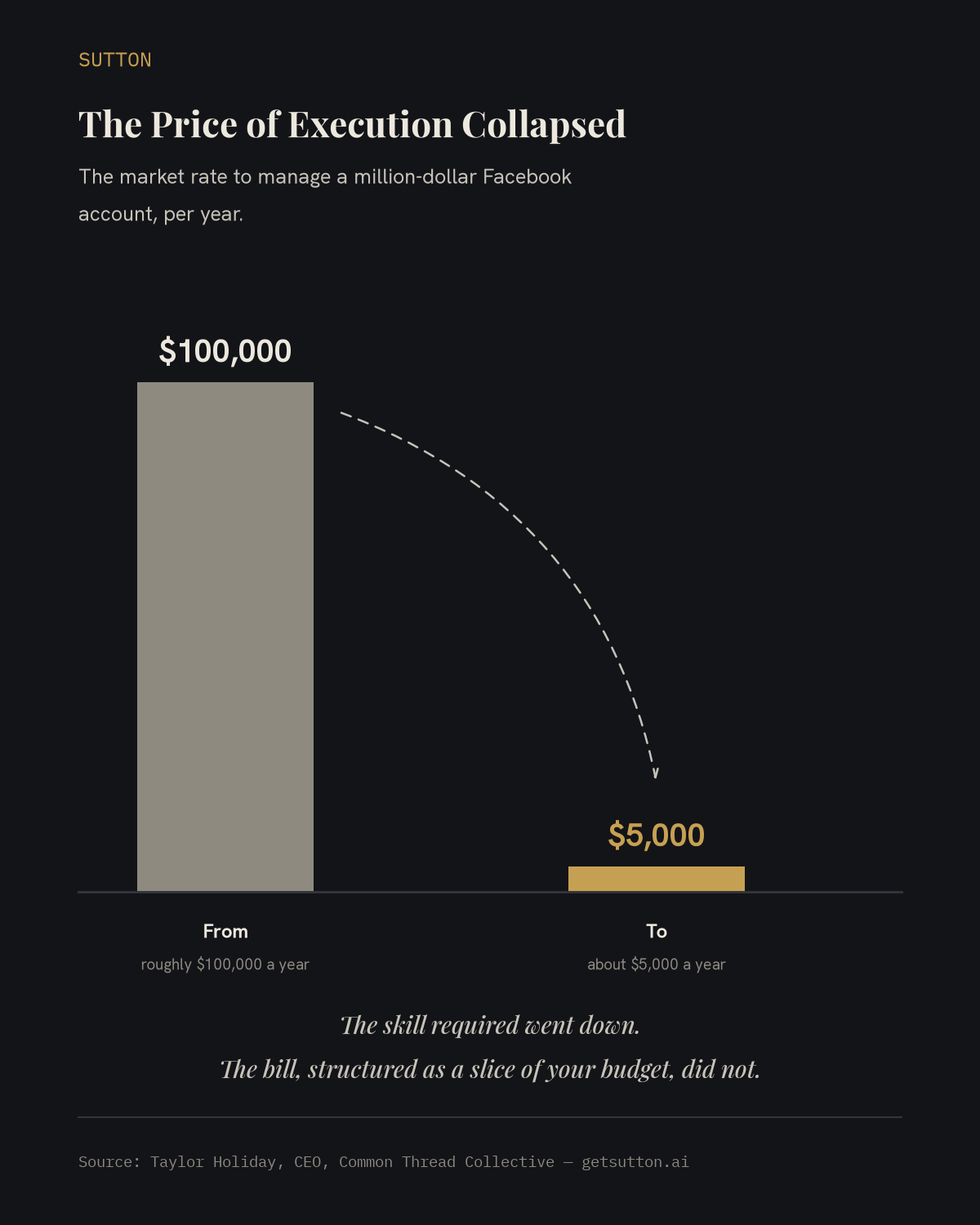
But execution has commoditized faster than the pricing built on top of it. Taylor Holiday of Common Thread Collective has described the market rate to manage a million-dollar Facebook account collapsing from roughly $100,000 a year to about $5,000, while percentage-of-spend billing sat on top of that shrinking cost unchanged. The skill required went down. The bill, structured as a slice of your budget, did not.
Cody Plofker, who built growth at Jones Road Beauty, found the sharper version from the buyer's side: "I had senior growth people who were uploading ads. You should be getting that off your plate to spend time on the higher-leverage things." The senior-level invoice was billing for judgment. The work landing on the account was upload, tag, launch: the commodity task seniority was supposed to buy you out of.
So an honest retainer has two line items. The fee for expertise, which is real and worth paying. And the fee for spend, which grows whether the growth behind it was earned or not.
The One Question That Predicts Everything
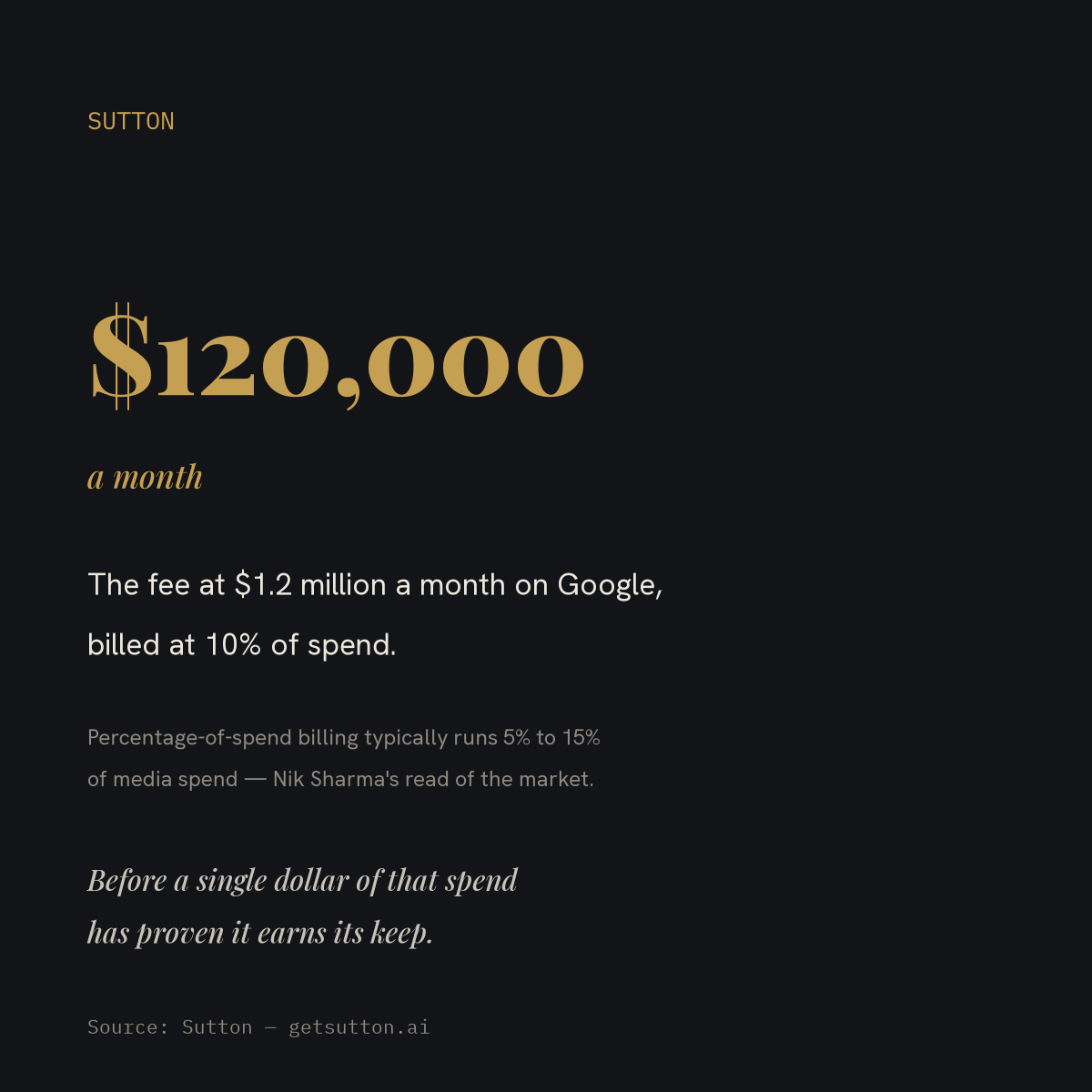
Ask any agency one thing before you sign: does your fee go up when my spend goes up? Percentage-of-spend billing typically runs 5% to 15% of media spend, by Nik Sharma's read of the market. Say a brand is at $1.2 million a month on Google. At 10%, the fee is $120,000 a month before a single dollar of that spend has proven it earns its keep. Recommend the 20% increase from the QBR, and the fee climbs with it, the same quarter.
Nik Sharma put the mechanism plainly: "their incentives are aligned around spending the most money they can." Not badly intentioned. Pointed that direction structurally, the way water finds low ground. Even the measurement side says as much. Olivia at Haus: "agencies are... mostly billing on percent of spend, and they have no incentive to tell or suggest to a brand that they... slow down." That is not a disgruntled customer. That is the industry's own read of its own pricing model.
And the number an agency optimizes toward is not always yours. Platform-reported ROAS and your actual contribution margin routinely disagree, and not by a rounding error. Curtis Howland, a DTC growth consultant, put it simply: "When Meta says ROAS is 4x and your P&L says you lost money, your P&L is right." A platform grades its own homework. An agency paid a slice of the spend that platform tracks has limited reason to argue with the math.
A fee that does not move with your spend earns the same whether you run $250,000 a month or $2 million. That property alone tells you more about how the advice leans, over two years, than any deck an agency has shown you. Structures like that exist.
The Real Choice: Agency, In-House, or a Fourth Option
Most $30M-plus brands frame the decision as agency versus in-house. Agency buys bench strength and fluency, but inherits the incentive problem plus the senior-sells-junior-runs pattern Plofker described. In-house solves the incentive outright, your team sits on your P&L, not a slice of your spend, but it caps out at however many people you can afford to hire. Eventually you are the senior person uploading ads, because there is nobody left to hand it to.
There is a fourth option that is not really an agency and not really a hire. A principal, not an agent: someone, or something, that runs the account with senior judgment on every seat, is on the hook for the outcome the way an owner would be, and is paid a fee that does not move with how much you spend.
Sutton is built as exactly that. Sutton is an AI carrying the encoded judgment of $150M in DTC sales driving 6 exits across our founding team, sold on a fixed monthly fee, no percentage of your ad spend, ever. Not a better agency. A different category of relationship, structured so the fee line cannot do to your account what it did in the opening scene.
Taylor Holiday has described what paid media needs as "software with a point of view," arguing that "Ads Manager is agnostic to your strategy." The platform spends your money as fast as you let it, with no opinion on whether that spend is earning. Something has to carry the judgment about when to push and when to hold, and be paid in a way that makes telling you the truth free.
Where the Alignment Argument Breaks
The case for percentage-of-spend deserves a fair hearing. It gives the agency upside when your account scales, and upside can feel like alignment: if the account grows, everybody wins. That holds until the marginal dollar stops returning what it used to. At that point the agency's incentive is still to keep the number climbing, because the fee is indexed to the number, not the return on it. Yours is to pull back. The fee sits on the wrong side of that gap exactly when it matters most.
The second defense is more honest: a good agency will tell you to slow down anyway. True, and not nothing. But notice what it asks you to rely on. Not a system. One person's willingness to argue against their own invoice, quarter after quarter, under pressure to hit their own targets. Virtue can hold for a while. Structure beats virtue over time, because structure does not have a bad quarter and virtue sometimes does.
What to Ask Before You Sign
Three questions do most of the work.
Who is actually doing the work. Ask who touches the account week to week, and whether that person is the seniority you were sold. If the senior person is uploading ads, you are paying for judgment you are not receiving.
What are they graded against. Platform-reported ROAS, or your own GA4 and your margin. If the answer is the platform's dashboard, the account is grading its own homework.
Does the fee move when your spend does. This is the one question. If yes, every recommendation to spend more carries a structural thumb on the scale, however good the people are. If no, you have an advisor with no financial stake in the number going up.
Match the model to your stage. A brand testing its first $20,000 a month may reasonably want an agency's bench, and does not run enough volume for a percentage fee to sting. A brand spending seven figures a month, with a Head of Growth whose name is on the number, has usually outgrown the version where the fee moves with the spend.
The Question Before the Deck
Picture the same Head of Growth, a year later, a different arrangement behind her. Before the deck opens, she asks one question: does your fee move with my spend. The answer, yes or no, tells her more about the next hour than the forty slides that follow it.
She still reads the deck. She still asks about creative, about bid strategy, about the state of the account. But she is no longer reverse-engineering someone else's incentive from a ROAS chart after the fact. She asked the one question before the meeting started this time, not in the lift on the way down.