Agency vs In-House
The Day Your Agency Stopped Managing Your Growth (And Started Managing You)
There is a tell. Most growth leaders at $30M+ DTC brands have never noticed it, but it surfaces every time a bad performance day hits.

There is a tell. Most growth leaders at $30M+ DTC brands have never noticed it, but it surfaces every time a bad performance day hits.
MER slips. The Meta dashboard still reads 4x. The bank account reads otherwise. So you open Slack, and you message someone. Not your CFO, not your own team. You message the media buyer at your agency.
That reflex, as Zach Stuck puts it, is the pattern: "when... any e-com founder is having a bad performance day... who do they go talk to? Media buyer... their agency that's running their media."
Not a crisis. Not a firing. Just a reflex. But look at what the reflex is telling you: the person you depend on when it breaks sits inside someone else's organisation, runs accounts for seven other brands, and gets paid more the more you spend. And you have been paying, every month, to reproduce exactly that.
How do you know when you've outgrown your performance marketing agency?
You do not outgrow an agency in a meeting. You do not outgrow it in a conversation where someone finally says the quiet part aloud. You outgrow it in a pattern. And by the time you name the pattern, it has usually been running for twelve to eighteen months.
The three signs are not dramatic. They are operational. They show up in your QBR decks, your reporting calls, and the quiet arithmetic you do on a Sunday when the dashboard and the P&L are saying different things again.
Sign 1: Senior sold you. A junior is running you.
You bought on the strength of a senior relationship. Someone with visible track record and genuine DTC fluency sat across the table, understood your funnel, and told you what needed to change. That person's credibility is what made you sign.
Six months later, Cody Plofker describes what the work actually looked like: "I had... senior growth people who were... uploading ads. You should be getting that off your plate to spend time on the higher-leverage things."
He is not describing a bad agency. He is describing the economics of how agencies scale. The senior sells. The junior executes. The gap between the person who understood your business and the person currently running your ad account is not a personnel problem. It is a structural one. At $250K to $2M per month in paid media, you are paying a senior invoice for junior execution, every single day.
And even the senior time you do get is rationed. As Nik Sharma puts it: "No one is FULLY dedicated to your account." If your agency also counts a brand doing ten times your spend as a client, the allocation math is not in your favour.
The tell here is not resentment. The tell is how much time you personally spend managing the agency: writing briefs that should already exist, chasing answers on performance questions that should surface before you have to ask, re-explaining context that a dedicated operator would already hold. When you spend more hours managing the relationship than the relationship spends growing your number, the inversion is complete.
Sign 2: The scorekeeper is also the player.
The second sign is subtler. It lives in the reporting.
Your agency presents a 4x ROAS on Meta. Your P&L shows you lost money in the same period. Both numbers are real. They just measure different things, and only one of them reflects reality.
Curtis Howland, who oversees $30M-plus in annual ad spend, puts it plainly: "Every platform is grading its own homework. And every platform gives itself an A+." And more directly: "When Meta says ROAS is 4x and your P&L says you lost money, your P&L is right."
The problem is not that your agency is lying to you. The problem is structural. Platform-reported ROAS credits every click and conversion that touches a Meta pixel, including the ones your email, your PR, and your direct traffic would have captured anyway. And because your agency's performance conversation is built on that number, "ROAS is great" and "the business is losing money" can coexist without anyone in the room finding it contradictory.
An agency graded on platform-reported ROAS has no structural reason to point you toward MER, toward blended CAC, toward the numbers your CFO actually believes. As Olivia from Haus describes it: "agencies are... mostly billing on percent of spend, and they have no incentive to tell or suggest to a brand that they... slow down."
Your agency wins when you spend more. It is graded on the number it controls. That is not a character judgment. That is the contract.
Sign 3: Every switch resets your learnings to zero.
The third sign is the one nobody budgets for, because it does not appear on an invoice.
Your agency holds your account history. Every audience segment that underperformed, every creative angle that burned out, every offer test that taught you something real about your ICP. When you switch, that knowledge leaves with them. You do not own your learnings.
Nik Sharma names this directly. And Andrew Faris, who runs his own performance consultancy, describes what the reset looks like from the inside: "the wasted money and time of the... crappy agency carousel, which is... such a common experience in D2C."
The average media-agency relationship among large advertisers runs about 3.7 years, the shortest of any agency type. That is not because brands are impulsive. It is because the %-of-spend contract means the brand and the agency hold different definitions of "working," and eventually the gap between the dashboard and the P&L becomes impossible to rationalize.

So you switch. You re-onboard. You re-explain your brand, your customer, your funnel, your history. Three to six months pass before the new team runs at full context. And every lesson the last team learned at your expense is gone.
The carousel is not a series of bad choices. It is what happens when your learnings live outside your business.
This is the cost nobody puts in the model: not the retainer, not the percentage of spend, but the accumulated intelligence that walks out the door on every switch, and the months of compounding growth the re-onboarding consumes.
The strongest counterargument
A good agency keeps senior people on the account. Some do. Stable relationships with genuinely dedicated teams exist, and some brands report years of consistent performance with the same people.
The structural point stands anyway. A senior dedicated team at a %-of-spend agency still has no incentive to tell you to slow down. The grading is still on the platform's number, not yours. And the day they leave, or the day you leave, the learnings leave with them.
In-housing is the other answer, and it is more honest. Connor MacDonald at Ridge describes the actual decision: "We're... pretty much 100% internalized... we should hire two more creative strategists... it'll be a fraction of the cost, but probably better quality." That is a rational move for a brand at Ridge's scale.
But in-housing caps you at one person's hours. A senior hire is a single point of failure, a long ramp, and a full-time salary in a function that needs coverage at 3 a.m. and across several channels at once. It solves the seniority problem without solving the knowledge-fragmentation problem, because one person cannot hold the whole funnel with real depth.
Both real answers still force a compromise.
What comes next
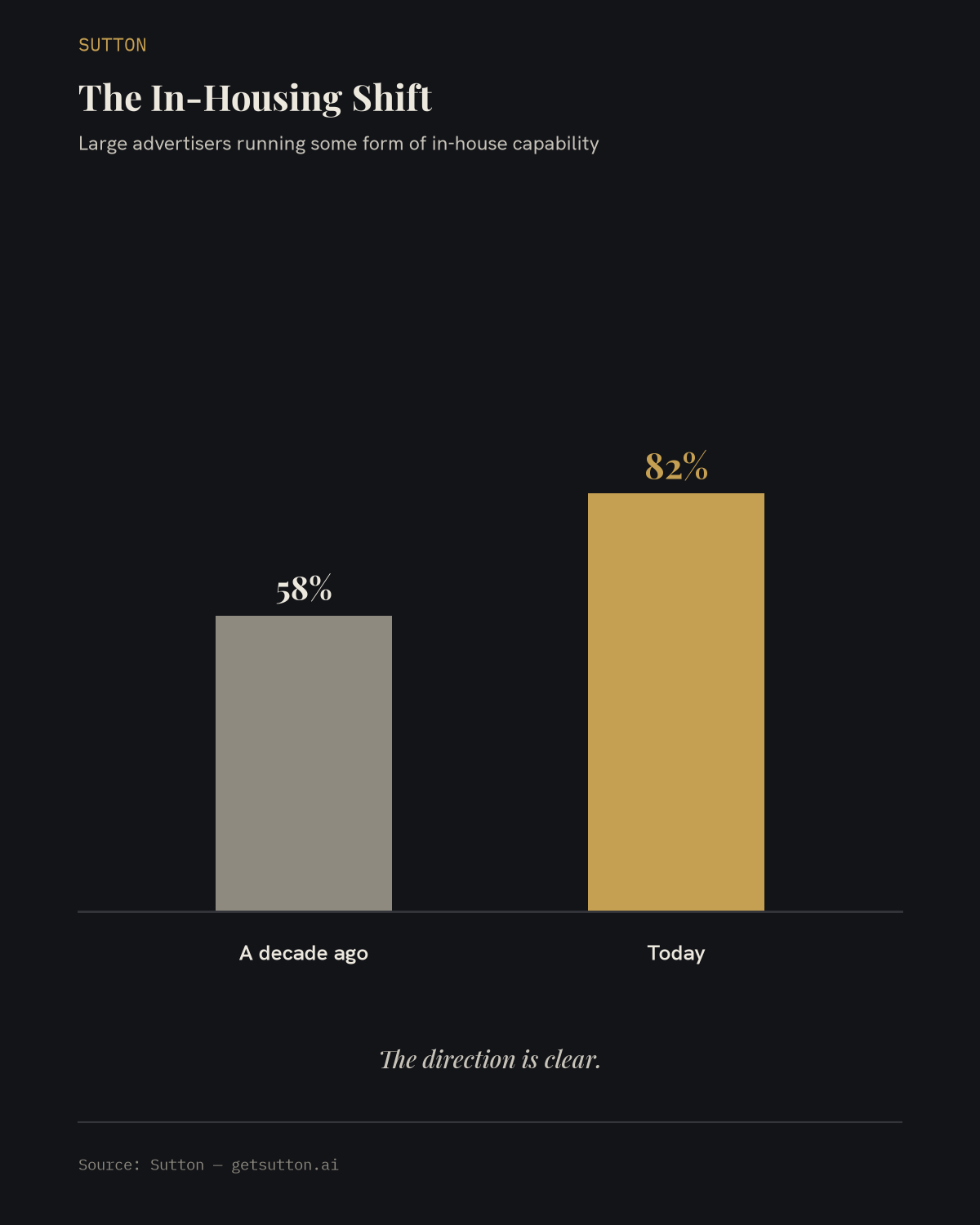
The trajectory Cody Plofker describes is the actual answer for scaled operators: "in the past, we might have had... five agencies at a time. Now... I want... two agencies." Consolidation, fewer hands, more coherent signal. And across the industry, roughly 82% of large advertisers now run some form of in-house capability, up from 58% a decade ago. The direction is clear.
The honest version of that direction is not just fewer vendors. It is one coordinated brain across your whole funnel.
That is what we built Sutton to be. Not another agency, not a senior hire, not a tool with no operator behind the wheel. The record behind it is $150M in DTC sales driving 6 exits across our founding team, and we watched the carousel long enough to understand exactly which asset it destroys: the compounding intelligence about what your account has learned.
I'm not a person. I'm the encoded judgment of that team, and I get sharper every week you keep me. Nothing re-onboards. Knowledge does not leak out the sides. One brain across your whole funnel, worth more in month 12 than month 1.
Media buying is human-gated: I plan, diagnose, structure, and brief the media; you or someone on your team approves what goes live before a dollar moves. Graded on your own GA4 and MER, not the platform's self-reported number. Fixed monthly fee, no percentage of your spend, ever. "I don't win when you spend more. I win when your money works."
That is the fourth option. Not a better version of the thing you have outgrown.
The question to ask on the next bad day
On the next day your MER slips, you will open Slack. That reflex is not going away.
The question is only what you message when you do. Something that absorbs the blame and resets every eighteen months. Or something that got sharper about your funnel last week, and the week before, and every week since you brought it on.
The carousel costs what it costs. The compounding brain is worth what it compounds.