Choosing & Switching
The Handover Is the Whole Job: How to Switch Marketing Agencies Without Losing a Quarter
The relief lasts about nine days.
The relief lasts about nine days. That is roughly how long it takes to go from signing the new agency to sitting on the first strategy call, watching someone you have known for a week pull up your ad account and ask why the top-of-funnel prospecting is built the way it is. Why the March lookalike got cut. What the creative angle was that actually worked, and when it stopped.
A Head of Growth answers as best she can, from memory and a Slack thread she cannot quite find. Somewhere around the fourth question she notices what is happening. She is not briefing a sharper team. She is re-explaining eighteen months of learnings, half-remembered, to people about to re-run tests her last agency already ran and lost. The relief curdles into dread. She did not hire a better team. She reset the clock.
Nobody selling you a switch wants to say this out loud, because their pitch depends on the new team being better than the old one. But the account never leaves when you change agencies. The reasons behind every decision do. And it is that undocumented judgment, not the new shop's talent, that costs you the quarter.
Where the cost actually sits
Call it the crappy agency carousel, because that is what the practitioners who watch it happen call it. "The wasted money and time of the crappy agency carousel, which is such a common experience in D2C," is how Andrew Faris, founder of AJF Growth, put it. He is describing something structural, not a run of bad luck. Every eighteen months or so, the relationship restarts from zero. New team, new assumptions, same tests run again because nobody wrote down that they already failed.
The reason it keeps happening is not incompetence. It is incentive. A performance agency billing a percentage of your spend has no built-in reason to make your exit smooth, because a clean handover does not help its business and a messy one rarely hurts it. "Agencies are mostly billing on percent of spend, and they have no incentive to tell or suggest to a brand that they slow down," is how Olivia, a growth lead at Haus, put it from the neutral seat. The same logic that keeps an agency from telling you to pull back also keeps it from prioritizing your offboarding. Nobody is paid extra to hand over a clean account.
That is not a knock on any single firm. It is what happens when the structure of the fee never rewards the exit. The cost of a switch is not a talent gap. It is a knowledge gap, and it sits exactly where the old agency had no reason to close it.
Document what only the old team knows, before anyone walks
If the loss is context and not competence, the fix starts as an inventory, not a search for a better agency. Before the outgoing team's access gets pulled, four things need to be captured in writing, because they live in people's heads and in nobody's dashboard.
Ad account structure and audiences. Every campaign, ad set, and audience running or paused, and why each is shaped the way it is. Not just what exists today, but what got tried and killed, and why. A lookalike that underperformed in Q1 is only useless information if nobody remembers the reason.
Pixel, conversions API, and server-side tracking. The exact configuration, including custom events, deduplication logic, and the server-side setup that took someone a week to get right. This is the layer most likely to break silently in a transition, and the layer least documented outside one engineer's memory.
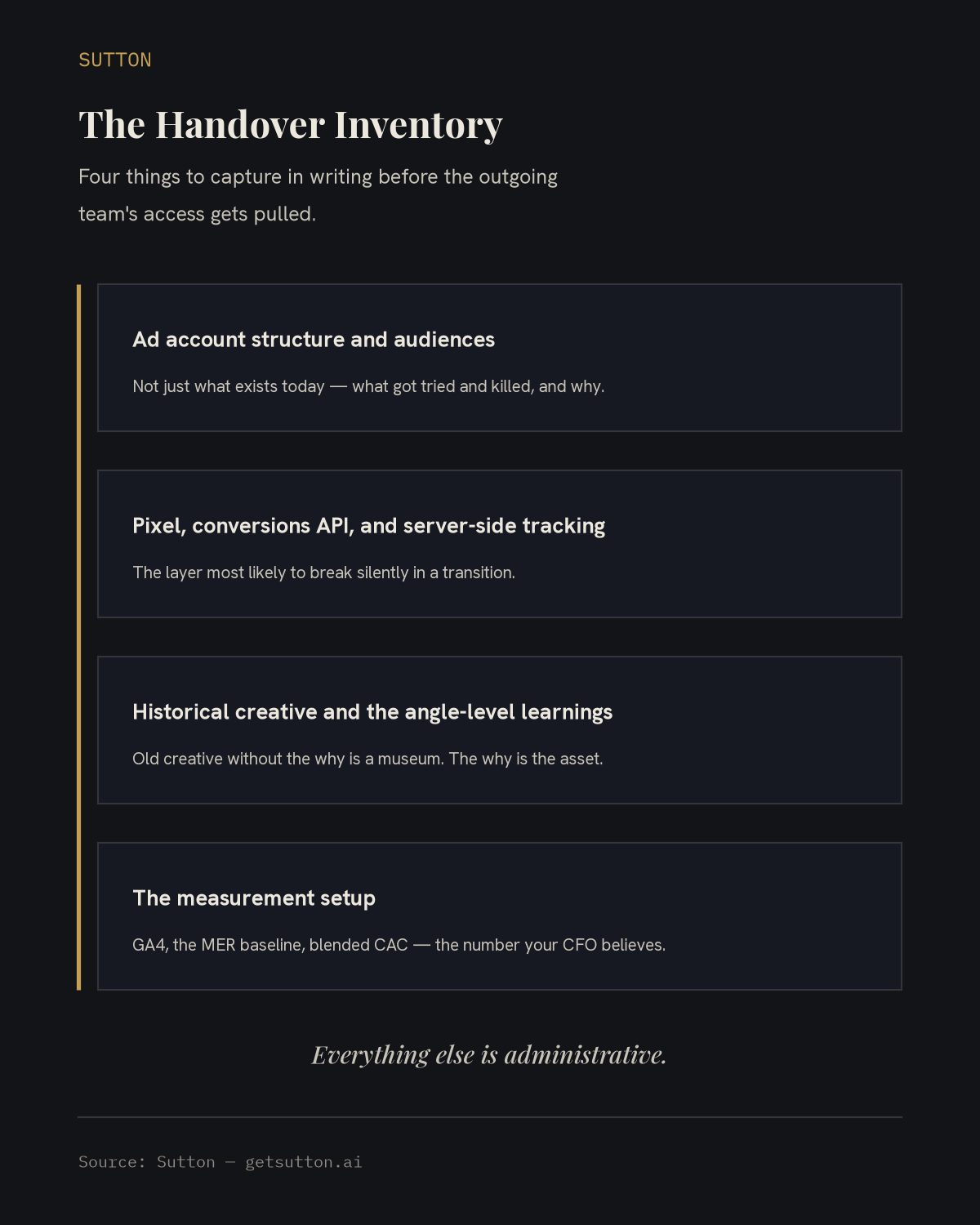
Historical creative and the angle-level learnings behind it. Not the raw ad library. The reasoning: which angle won, which lost, and what the team believed explained the difference. A stack of old creative files without the why is a museum. The why is the asset.
The measurement setup. GA4 configuration, the MER baseline you track against, and blended CAC by channel. This is the number your CFO believes. If the new team inherits a different definition without knowing, your first month of reporting will read like a discontinuity that never happened.
This is the marketing agency transition checklist that matters. Everything else, brand guidelines, logins, contact lists, is administrative. These four items are the difference between a new team that continues your account and one that starts a different account that happens to share your logo.
Run the overlap, not the cliff edge
Documentation only works if someone is still around to hand it off, which is why a clean switch runs on an overlap window instead of a hard cutoff. Keep the outgoing agency engaged, on a short paid extension if that is what it takes, long enough that accounts, pixels, and platform history transfer while someone still owns the account and can answer a question about it.
The failure mode is the gap week. The old team has already checked out because the contract is ending and there is no upside left in staying sharp. The new team is not yet provisioned: no admin access, no historical exports, no answers. Spend either freezes because nobody wants to touch a live account they do not understand, or it runs unmanaged because nobody has taken the wheel. Either way, the brand pays for a week or more of an account nobody is steering. Most switches get this part wrong, because it happens in the seam between two contracts and belongs to neither party.
Onboarding the next partner against the documented context is the other half. A team that inherits the four-item inventory acts on what is known. A team that inherits a login and a Slack invite spends its first weeks proving, expensively, that the old lookalike really did underperform.
"Just write it down" is most of the answer, and not all of it
The honest objection is that this is a documentation problem, not an architecture problem: write a good handover doc, and any competent agency picks up where the last one left off. That is mostly true, and the checklist above is the mechanism. A brand that does nothing else but capture those four items before its next switch will lose far less than one that does not.
But a handover document is a snapshot, and judgment is not. Why an audience got cut in March is a decision built from context nobody wrote down in full: half a dozen small signals, a gut call, a tradeoff against a launch that was coming. Six months later, even the person who made the call may not remember all of it. A document freezes what someone thought to write on the day they wrote it. It does not compound. It decays a little with every switch, the way a photocopy of a photocopy loses resolution it can never get back.
Documentation shrinks the quarter you lose. It does not erase it. The only thing that erases it is a model where the judgment never has to be re-explained, because it never left.
Where this leads
That is the case for building intelligence that does not re-onboard. It runs as one compounding brain across your whole funnel, worth more in month 12 than month 1, because nothing re-onboards and knowledge does not leak out the sides. It is $150M in DTC sales driving 6 exits across our founding team, encoded so the reasoning behind a decision survives past the person who made it. It plans and briefs the next quarter's media against everything it knows about your account. You still approve what goes live. That is not a promise your next switch will cost nothing. It is a different answer to the question this piece has been circling: not who you should hire next, but whether the next handover has to be a reset at all.
Back to the call
Picture the next switch, whenever it comes. The Head of Growth is on a strategy call again, except this time the first question from the other side is not "why was this audience cut." It is already in the notes, along with what was tried after and what that taught. Nobody re-runs a test that failed eighteen months ago, because eighteen months ago never left the room. The win was never a better re-explanation. It was not having to explain at all.