Choosing & Switching
The Quarterly Agency Audit: Four Questions the Deck Is Built to Avoid
The room is warm.

The room is warm. Forty slides into the quarterly business review, every arrow points up and to the right. The account lead walks through platform ROAS, 4.1x this quarter, up from 3.6x last, and the slide gets a nod from around the table. Two nods. One from the coordinator taking notes. One from the growth leader, who stopped listening a minute ago and started doing math in her head.
The number on the screen does not match the number her CFO sent Tuesday morning. Net revenue down. Blended CAC up. Nothing on this deck bridges the gap between what the ad platform says happened and what the bank account says happened.
Nobody asks about the gap. The deck was built so nobody has to.
A quarterly business review is not neutral. It is not a report card written by a third party. It is an artifact produced, formatted, and narrated by the party being measured, presented to the party doing the measuring, in a room where one side showed up with a spreadsheet and the other showed up with a story and forty minutes of momentum.
Run four audit questions on your agency every quarter, not just at renewal, and underperformance surfaces months before the deck can smooth it over. Three of the four, the QBR is built to answer for you, on its own terms. The fourth, no agency can answer honestly, because the answer was fixed the day the contract got signed.
Question one: which number are we actually being graded on?
Every deck needs a hero metric, and platform-reported ROAS is the easiest one there is. Fast, flattering, and produced by the same company selling you the ad inventory. Meta scores Meta. Google scores Google. Nobody grades their own homework and comes back with a C.
"Every platform is grading its own homework," says Curtis Howland, the DTC growth consultant. "And every platform gives itself an A+."
Attribution windows get generous. View-through conversions get counted as purchases. Cross-device behavior gets modeled, not measured. None of it is fraud. All of it is tuned to make the platform look indispensable, because the platform's growth depends on you believing it is.
Howland's second line belongs above every growth leader's desk: "When Meta says ROAS is 4x and your P&L says you lost money, your P&L is right." Your P&L has no incentive to flatter the channel. It has one job: tell you what happened to the cash.
So ask it plainly. Which number is the agency graded on, quarter over quarter, in writing? If the answer is platform ROAS, you are grading the agency on a number its media partner controls the definition of. If the answer is your own GA4 revenue and your own marketing efficiency ratio, the agency is being graded on your reality. Ask which one shows up in the contract, not just the deck.
Question two: who is actually running the account?
The pitch meeting had a partner in the room. Fifteen years of experience, a case study for a brand you recognize, sharp answers to hard questions. Six weeks later, the day-to-day is a coordinator two years out of school, learning your account in real time, cc'ing a partner who never reads the thread.
This is not a rare failure. It is close to the standard model past a certain size: senior talent sells, junior talent executes, and the gap gets managed with a Slack channel and a monthly check-in.
Nik Sharma, who has sat on both the brand and the agency side of this, put it plainly: "No one is FULLY dedicated to your account." Every agency runs a portfolio. Every account manager splits attention across a book of clients, and the account that got the most senior attention was the one being pitched, not the one being run.
The question is concrete, not rhetorical. Who is in the weekly working session, by name and title, and has that person changed in the last two quarters? A senior invoice paying for junior execution is not a scandal. It is the default. The only way to know if it is happening to you is to ask, on the record, before it becomes the explanation for a bad quarter.
Questions three and four: does the fee rise with the spend, and where are the learnings written down?
Here is the structural fact underneath most agency relationships. The standard fee model is a retainer plus a percentage of ad spend, usually 10 to 20 percent. It sounds like alignment. More spend, more results, more fee, everybody wins.
Except the fee is tied to spend, not to result. Spend more and the agency gets paid more, whether or not the incremental dollar produced an incremental sale. Sharma names it directly: "their incentives are aligned around spending the most money they can." Not the most money that works. The most money. Period.
This is the one audit question a deck cannot dress up, because its answer is not a narrative choice. It is a term in the contract. The deck can reframe a soft quarter as a testing phase. It can present a junior team as close collaboration. It cannot change what percentage of spend the agency is owed. That number is the same in a good quarter and a bad one.
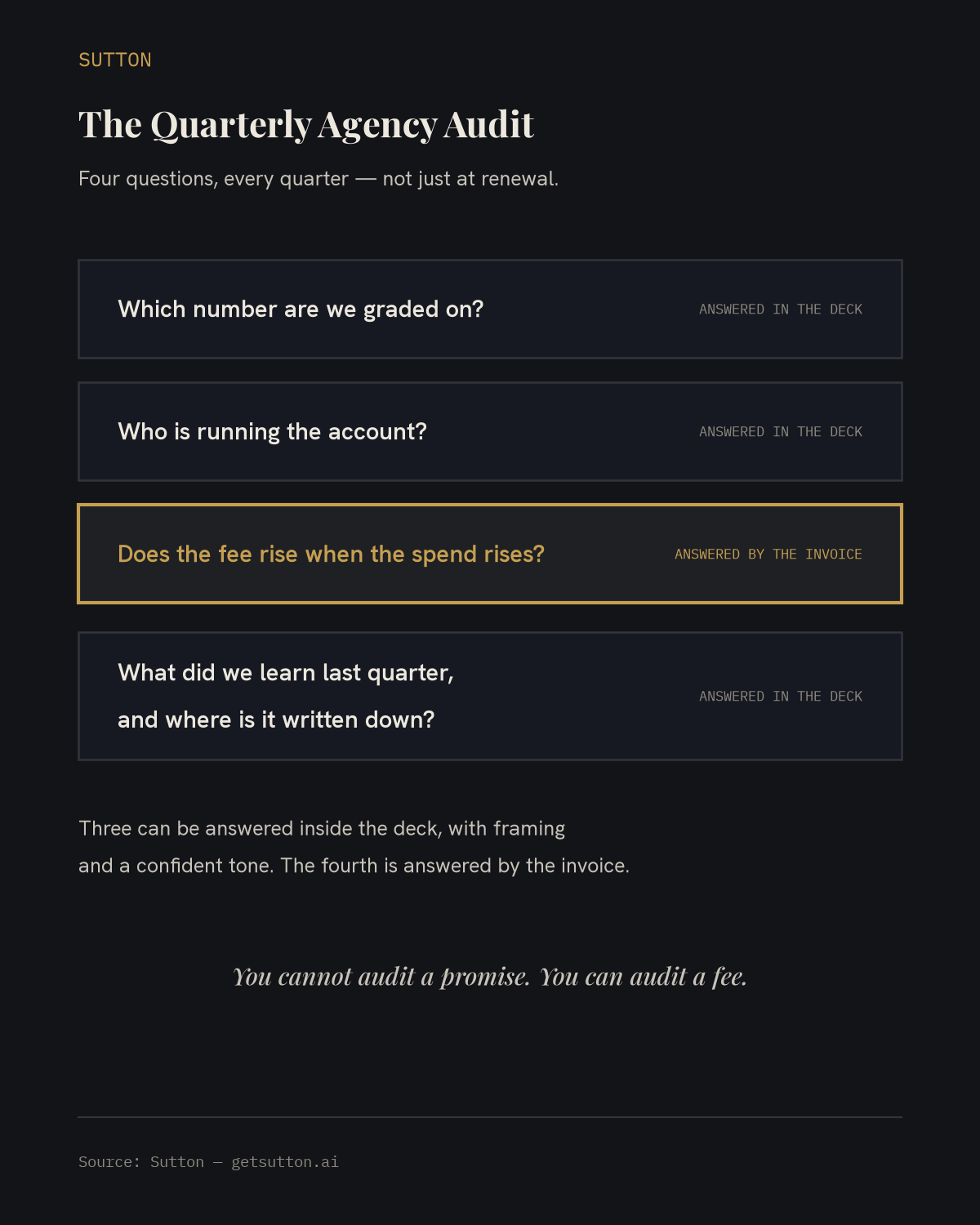
That is why it catches underperformance months earlier than the other three. The others can be answered inside the deck, with framing and a confident tone. This one is answered by the invoice.
The fourth question rides alongside it: what did we learn last quarter, and where is it written down? Sharma again: "You don't own your learnings." Ask an agency for the full record of what was tested, what failed, what worked, and why, in a format you keep whether or not the relationship continues, and watch how many can produce it. Most of the knowledge about your own account lives in someone else's head, someone else's dashboard, someone else's Slack history. When the relationship ends, it walks out the door.
Two objections, argued honestly
The first is fair. Every agency says its incentives are aligned. How is a fixed fee different from what mine already promises?
Because a promise and a contract are not the same thing. A verbal commitment to restraint costs the agency nothing to make and nothing to break. A percentage-of-spend fee rewards the opposite of restraint no matter what anyone says in the QBR, because the structure pays more when you spend more. You cannot audit a promise. You can audit a fee.
The second cuts deeper. Can I trust anything other than a senior human I can see, across the table, to make the call on a serious media budget?
That is the right instinct, and it deserves a real answer. The audit does not ask you to trust a promise about diligence. It asks who is on the hook for the outcome and whether a human approves before the dollar moves. That is a verifiable structure, not a character reference. Even people inside the agency world concede the point. Luke Austin, VP of ecommerce strategy at CTC, put it this way: "someone's also got to make a judgment call, and be on the hook for the outcome." The question is not whether a human is involved. It is which human, with what accountability, and whether you can see it.
The fourth option
If the incentive question is where most agency arrangements structurally fail, the fix is not a better agency. It is a different structure.
That is what Sutton is built to be: a fourth option for a $30M+ DTC brand, sitting alongside a full-service agency, an in-house team, or a freelance patchwork. A fixed monthly fee, no percentage of your ad spend, ever. Graded against your own GA4 and your own marketing efficiency ratio, the numbers your CFO believes, not platform-reported ROAS. Built on the operating record behind $150M in DTC sales driving 6 exits across our founding team.
None of that replaces the audit. It just means Sutton can pass one.
The scorecard
Four questions. Run them every quarter, on your current agency, on an in-house team, on whoever is spending your media budget right now. Which number are we graded on. Who is running the account. Does the fee rise when the spend rises. What did we learn last quarter, and where is it written down.
Run it this quarter, whether or not you ever change a single vendor.
Because the next time the room is warm, the deck is forty slides, and every arrow points up and to the right, you will already have your own numbers in your pocket. And you will be the one who asks.